




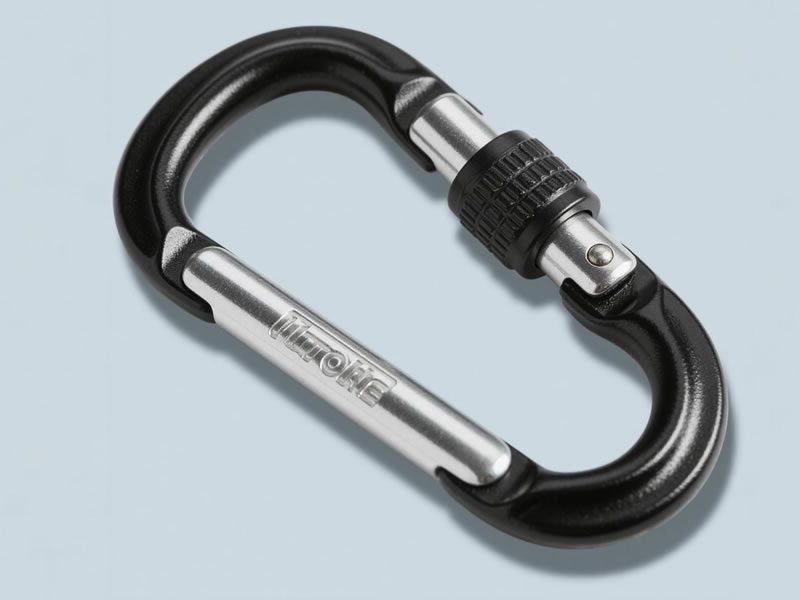
Carabiner with a Secure Double Lock
In the realm of safety-critical connections, a standard screwgate carabiner represents a significant step up from a non-locking biner. However, for the most demanding applications—where accidental opening could lead to catastrophic consequences—a higher level of security is required. This is the domain of the double-locking (or triple-action) carabiner. These devices feature mechanisms that require two or more distinct, intentional actions to open, providing a formidable defense against inadvertent gate release caused by snagging, vibration, or user error.
Recommended trekking pole purchase link: https://s.click.aliexpress.com/e/_c4M7OWaN
The "Double Lock" Defined: Beyond the Screwgate
A "double lock" does not simply mean two screw collars. It refers to a design where the gate must be unlocked through a multi-step, sequential process that is unlikely to occur accidentally.
- Standard Screwgate: One action: unscrew the collar, then press the gate.
- Double/Triple-Action Lock: Examples: Press then twist, or Pull, then press, then twist. The gate cannot open unless the specific sequence is followed.
Primary Mechanisms and Leading Examples
- Ball Lock (Petzl): A widely trusted double-action system.Mechanism: To open, you must first press the gate inward to disengage a locking ball from a detent, and then rotate it around the axis. It cannot be opened by pressure or twisting alone.Example Models: Petzl Am'D Ball Lock, Petzl OK Ball Lock.Best For: General high-security applications, rigging, anchors, and situations where the carabiner might be dragged over edges or through debris.
- TriAct Lock (Petzl): The pinnacle of user-engineered security, offering triple-action operation.Mechanism: Requires a deliberate three-step sequence: Pull the sleeve back, Press the gate in, and Twist to open. This is exceptionally resistant to accidental opening.Example Models: Petzl Triact.Best For: Technical rescue, high-angle work, and any scenario where a connection is "hands-off" for long periods or subject to extreme abrasion and entanglement risk.
- Dual-Gate Systems (GridLock / TwinGate): A different approach to redundancy.Mechanism: Features two independent, sequential gates that must both be opened. The outer gate often operates like a sleeve that must be pulled back (first action) to access the inner spring-loaded gate (second action).Example Models: Black Diamond GridLock.Best For: Users who prefer a linear, pull-back then press-gate action. Excellent for securing devices where rope movement might otherwise manipulate a single gate.
Critical Applications: When is a Double Lock Necessary?
These are not for everyday sport climbing quickdraws. Their complexity and weight are justified in specific fields:
- Technical Rescue & Rope Access: Where systems are complex, environments are chaotic, and a failure could cost lives.
- High-Risk Hauling & Rigging: In big-wall climbing or industrial settings, where loads are heavy and systems are under constant tension and movement.
- Fixed Lines & Safety Lines: Where the carabiner may be subject to constant rubbing against rock or structure.
- Master Points in Critical Anchors: Providing an extra layer of security at the heart of a life-support system.
- For Users with Reduced Dexterity: The sequenced action can be more intuitive and secure for some than ensuring a screwgate is fully threaded.
Trade-offs and Considerations
- Weight & Bulk: Double-lock mechanisms are heavier and often larger than equivalent screwgates.
- Operation Speed: They are slower to open and close than a screwgate. This is the intentional trade-off for security.
- Dexterity Requirements: Operating them with thick gloves or cold hands can be challenging and requires practice.
- Cost: They are significantly more expensive due to their complex manufacturing.
- Certification: All major models are UIAA/CE certified, meeting the same strength standards as other climbing carabiners.
Comparison to Other Locking Types
| Type | Security Against Accidental Opening | Speed of Use | Weight/Bulk | Ideal Use Case |
|---|---|---|---|---|
| Screwgate | Good (if fully locked) | Fast | Low | Belaying, general climbing anchors |
| Auto-Locking (Twist) | Very Good | Medium | Medium | Frequent clipping/unclipping where auto-lock is preferred |
| Double/Triple-Action | Exceptional | Slow | High | Rescue, fixed systems, high-consequence rigging |
Final Recommendation and Verdict
The "secure double lock" carabiner is a specialized tool for specialized tasks. For most climbers, a conscientiously used screwgate is sufficient. However, when the consequence of error is severe, the added security is invaluable.
- For all-around high-security versatility, the Petzl Ball Lock system is the benchmark, offering excellent protection in a relatively user-friendly package.
- For the absolute highest security in professional or rescue contexts, the Petzl TriAct is the definitive choice, with its intuitive yet highly complex triple-action sequence.
- For users who prefer a linear, dual-gate action, the Black Diamond GridLock provides robust and reliable two-step security.
Choosing a double-lock carabiner is a statement of risk management. It signifies an understanding that in certain environments, the highest level of mechanical security is not an extravagance, but a fundamental component of a safety-first philosophy. Always pair this hardware with the knowledge and training required for its intended application.




