




Measuring Carabiner Strength: kN to lbs Conversion and What It Really Means
When evaluating a carabiner's strength, the most important specification is its force rating, expressed in kilonewtons (kN). For those accustomed to pounds (lbs), this unit can be abstract. Understanding the conversion is more than a mathematical exercise—it’s fundamental to grasping the immense forces involved in safety-critical activities and why carabiners are rated as they are.
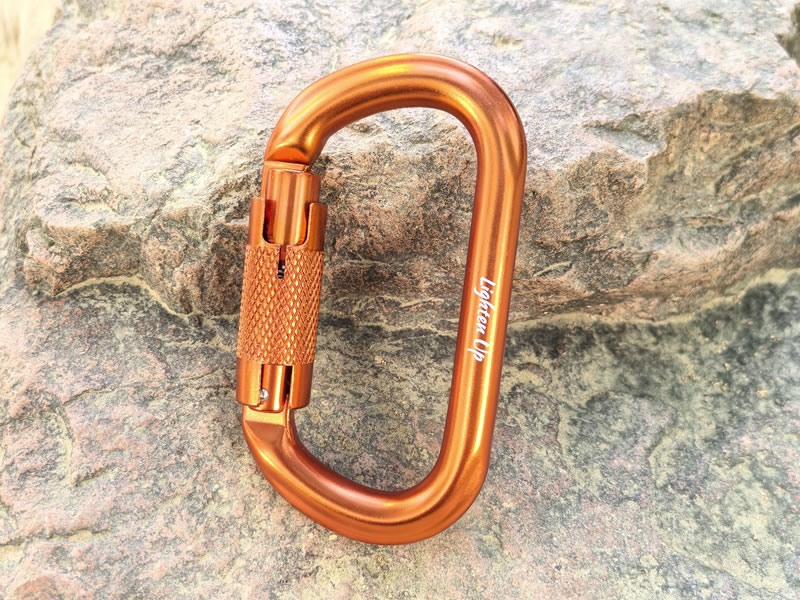
What is a Kilonewton (kN)? The Unit of Force
A newton (N) is the International System of Units (SI) measure of force. One kilonewton (kN) equals 1,000 newtons. Crucially, it is a measure of force, not mass. This distinction is key because a falling body generates dynamic force far greater than its static weight.
The Essential Conversion:1 kN ≈ 225 lbs (pounds-force)
This approximation (224.8 lbs, to be precise) is the cornerstone for understanding carabiner ratings.
Applying the Conversion: Real-World Examples
Using the 1 kN ≈ 225 lbs conversion, common carabiner ratings translate as follows:
- 22 kN (Standard Climbing Carabiner):22 kN x 225 lbs/kN ≈ 4,950 lbsThis is the minimum breaking strength along the major axis (gate closed) under ideal, slow-pull laboratory conditions.
- 30 kN (High-Strength/Locking Carabiner):30 kN x 225 lbs/kN ≈ 6,750 lbs
- 7 kN (Typical Minor Axis/Cross-Loaded Strength):7 kN x 225 lbs/kN ≈ 1,575 lbsThis illustrates the dramatic strength reduction when force is applied sideways to the gate.
Why kN, Not Pounds? The Industry Standard
The global outdoor and safety industries use kN for critical reasons:
- International Consistency: kN is a universal scientific standard, eliminating confusion between imperial and metric systems in global markets.
- Precision in Standards: Certification bodies like the UIAA (International Climbing and Mountaineering Federation) and CE define their rigorous testing protocols in newtons. Using kN ensures direct compliance with these standards.
- Clarity of Magnitude: The numbers are manageable. Discussing forces of "22 kN" is more practical than "4,950 lbf."
Critical Interpretation: Breaking Strength vs. Safe Working Load
This is the most vital concept. The kN rating stamped on a climbing carabiner is its Minimum Breaking Strength (MBS).
- It is NOT a "safe working load." You should never subject a carabiner to forces even remotely close to its kN rating during normal use.
- It is a DESTRUCTIVE test result. This is the force at which the manufacturer guarantees the carabiner will not break in controlled testing.
- Real-World Forces are Lower: A severe climbing fall typically generates 2-5 kN of impact force on a top carabiner, carefully managed by the rope's elasticity to stay well within the gear's capacity.
The Limits of Conversion: What the Math Doesn't Tell You
Simply converting kN to lbs does not give you permission to use a carabiner for that weight in a different context (e.g., towing). The rating is specific to:
- Controlled Laboratory Conditions: Slow, straight-pull tension.
- Specific Load Orientation: Major axis (spine-to-gate), minor axis, or gate-open tests are all different.
- A Brand-New, Undamaged Carabiner. Nicks, corrosion, and wear drastically reduce strength.
- Dynamic vs. Static Loads: The dynamic shock load of a fall or a tow strap jerking can multiply force instantly.
Conclusion: Conversion as a Tool for Understanding, Not Calculation
Converting 22 kN to ~4,950 lbs is primarily an educational tool. It powerfully illustrates the incredible engineered strength packed into a small piece of aluminum alloy and underscores the seriousness of the safety standards involved.
The practical takeaway is this: For a climber or safety professional, you do not need to calculate forces in the field. Instead, you must:
- Use only UIAA/CE-certified gear with a clear kN rating.
- Understand that the system (rope, anchor, belay) is designed to keep forces well below these thresholds.
- Never use the converted pound value to justify using a climbing carabiner for rigging, lifting, or towing, where different standards (Working Load Limit) apply.
Let the kN rating stand as the authoritative measure of a carabiner's tested, destructive limit. Your job is to ensure it never sees forces even a fraction of that magnitude through proper technique and system design. The conversion to pounds serves to inspire respect for the engineering, not to become a working parameter.




