




“Mini” vs “Regular” Carabiner, What’s the Difference? A Guide to Purpose-Driven Design
At first glance, mini and regular carabiners seem to be the same tool in different sizes. However, the difference is not merely one of scale; it is a fundamental distinction in engineering philosophy, intended use, and safety certification. Choosing the wrong type can range from a minor inconvenience to a life-threatening error. This guide breaks down the critical differences to ensure you select the right connector for the task.
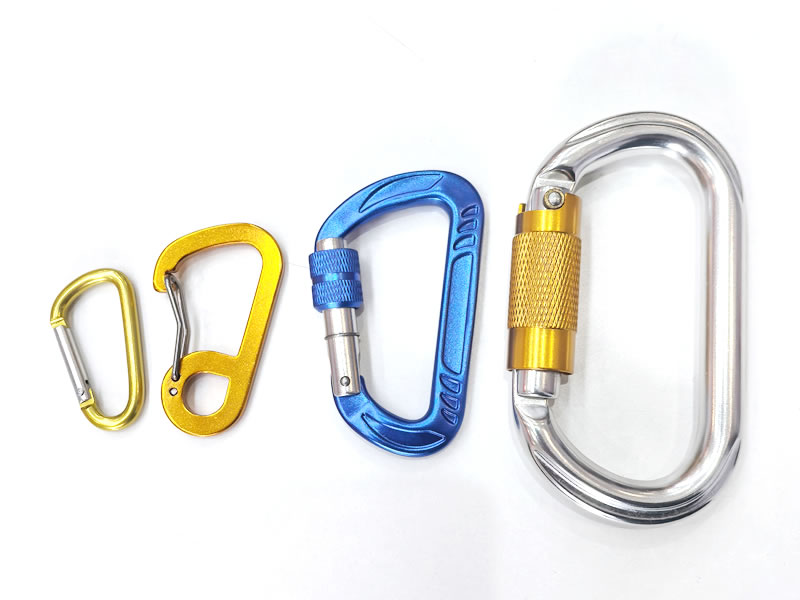
1. Physical Dimensions and Scale
The most obvious difference is size, which dictates their entire function.
- Mini Carabiner: Typically measures under 2.5 inches (6-7 cm) in length. The gate opening is often just large enough for a key ring or thin webbing. It is designed to be lightweight and unobtrusive.
- Regular Carabiner: The standard workhorse, usually around 3.5 to 4 inches (9-10 cm) long. It has a significantly larger gate opening and internal basket, designed to accommodate climbing ropes, belay devices, and multiple slings with ease.
2. The Core Distinction: Safety Certification and Strength Rating
This is the most critical, non-negotiable difference.
- Mini Carabiner: Utility-Only.No Safety Certification: Minis are classified as general hardware or organizational gear. They are not certified by the UIAA (International Climbing and Mountaineering Federation) or CE as Personal Protective Equipment (PPE).No kN Rating: You will not find a kilonewton (kN) strength rating stamped on a mini carabiner. Their strength is unknown and untested for dynamic loads. They may be rated for a few kilograms of static pull in marketing materials, but this is not a safety guarantee.Gate Mechanism: Most feature simple, non-locking snap gates. Even those with a screw-lock sleeve are for convenience, not life-support security.
- Regular Carabiner: Life-Support Rated.Full Certification: A true climbing or safety carabiner is rigorously tested to meet UIAA/CE standards (e.g., EN 12275).Clear kN Rating: Its strength is clearly stamped (e.g., 22 kN, 24 kN). This indicates its Minimum Breaking Strength under ideal conditions—roughly 4,950 lbs for a 22 kN carabiner.Secure Locking: For critical applications, regular carabiners come with screwgate, auto-locking, or twist-lock mechanisms designed to prevent accidental opening under load or impact.
3. Material and Construction Philosophy
- Mini Carabiner: Prioritizes low weight and cost. Often made from lighter, sometimes less durable aluminum alloys, or even zinc. The gate spring and pivot are designed for convenience, not maximum resilience.
- Regular Carabiner: Prioritizes strength and reliability. Made from high-strength, heat-treated aluminum alloys (e.g., 7075-T6) or steel. Every component, from the spine to the gate spring, is engineered to withstand shock loads, abrasion, and extreme environments.
4. Appropriate and Inappropriate Uses
Use a MINI Carabiner for:
- Organizing keys on a keyring.
- Attaching a small accessory (whistle, bottle opener) to a backpack's daisy chain.
- Hanging a lightweight item like a camp towel from your pack.
- In short: For organizing gear where failure would be a nuisance, not a catastrophe.
Use a REGULAR Carabiner for:
- Any life-support activity: Rock climbing, belaying, rappelling, rope access, industrial fall arrest.
- Building climbing or rescue anchors.
- Securing heavy or critical gear where a dropped item would be dangerous (e.g., a camera over a cliff, a tool at height).
- In short: For any connection where human safety or significant loss depends on its strength.
The Danger Zone: Common Misconceptions
The greatest risk is assuming a mini carabiner is a "small climbing carabiner." It is not.
- Never use a mini carabiner to clip a dog's leash to its collar if the dog is strong enough to generate shock loads.
- Never use one as the primary connection for a gear sling on a climb.
- Never trust it to hold a person's weight in any scenario, even for a brief moment.
The Grey Area: High-Strength "Mini" Carabiners
Some reputable brands (like Camp, DMM) make small, certified locking carabiners with kN ratings. These are technically "mini" in size but "regular" in safety certification. They are specialized tools for alpine climbing where every gram counts, to be used by experts in specific, non-critical clipping roles. They are not the same as the unrated mini carabiners sold in multipacks at hardware stores.
Conclusion: Choose by Purpose, Not Just Size
The divide between "mini" and "regular" is the divide between convenience and safety. Your choice should be driven by a simple question: "What are the consequences if this connection fails?"
- If the answer is "I'd lose my keys or be annoyed," a mini carabiner is a perfect, lightweight solution.
- If the answer is "Someone could be injured or die," you must use a certified, rated, regular climbing carabiner.
Respecting this fundamental difference is key to safe practice. Let the stamped kN rating and UIAA/CE mark be your guide. When in doubt, always err on the side of the stronger, certified tool. Your gear, and your safety, depend on using the right connector for the job.




