




Best Carabiner for Tow Strap or Vehicle Recovery: The Critical Difference Between Life-Saving and Lethal
The moment a vehicle is stuck—be it in deep mud, sand, or snow—the priority is a safe and effective recovery. In this high-stakes scenario, the instinct to reach for a familiar "strong-looking" carabiner as a quick connector for tow straps is not just wrong; it is extremely dangerous. The central, non-negotiable truth is this: Standard climbing, hardware, or general-purpose carabiners are never safe for vehicle recovery. The correct and only acceptable answer for connecting recovery gear is a rated, forged steel bow shackle or a modern synthetic soft shackle.
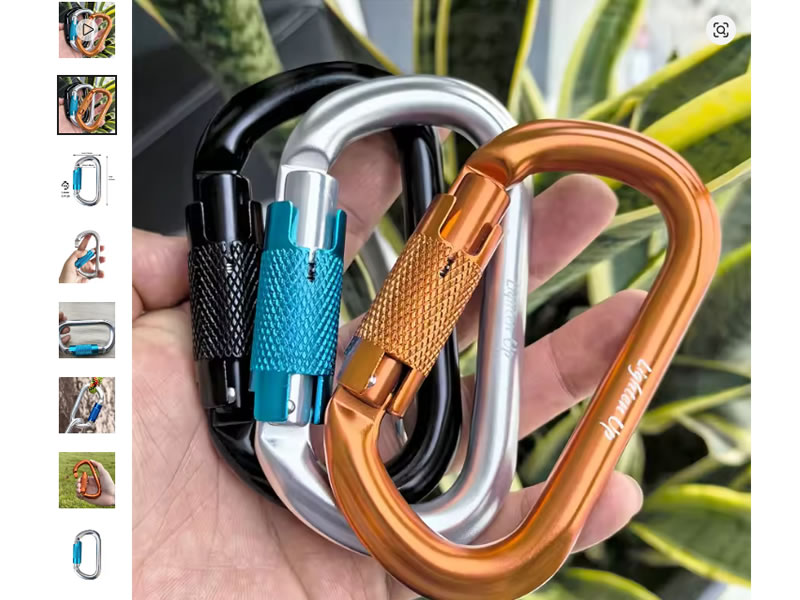
Buy Link: https://www.aliexpress.com/item/1005006960024275.html
Why a Standard Carabiner is a Catastrophic Risk
Vehicle recovery generates forces that are orders of magnitude greater than those in climbing or gear organization. These forces are often shock-loaded—a sudden, violent jerking that multiplies the static weight of the vehicle. A carabiner is designed for largely linear, controlled loads along its major axis.
- The Danger of Cross-Loading: In a recovery, the strap can instantly force the carabiner into a cross-loaded or three-way pull position. This applies force across its weaker minor axis. A carabiner rated for 22 kN (~4,950 lbs) in its strong direction may fail at under 8 kN (~1,800 lbs) when cross-loaded—a force easily exceeded in even a mild recovery yank.
- Gate Failure: The gate is the weakest point. A sudden shock load can cause a spring or screw-lock gate to fail open, or the nose to hook and then disengage under shifting tension.
- Material Failure: High-grade aluminum alloys used in climbing can be brittle under sharp, shock-loaded impacts. Failure is often catastrophic and explosive, sending high-velocity metal shrapnel toward participants—a phenomenon known as a "shackle bomb."
The Correct Tool: The Forged Steel Bow Shackle
This is the industry-standard connector for a reason. When people mistakenly ask for a "recovery carabiner," this is what they actually need.
- Material & Construction: Made from heat-treated, forged steel for immense strength and ductility (the ability to bend slightly without shattering).
- Design for the Task: The rounded "bow" shape is critical. It allows a recovery strap's loop to sit naturally, distributing load evenly and preventing the strap from being pinched or cut at sharp corners.
- Secure Pin: A screw-type pin with a shoulder ensures it cannot vibrate loose and is captive even when unscrewed. It should always be hand-tightened and never over-torqued.
- Clear Load Ratings: A proper shackle is marked with its Working Load Limit (WLL) and a safety factor (typically 4:1 or 5:1). For a typical 4WD, a WLL of 4.75 tons (9,500 lbs) or higher is standard. This is not the breaking strength; the breaking strength is 4-5 times higher, providing a crucial safety margin.
The Modern Alternative: The Synthetic Soft Shackle
Increasingly favored in advanced recovery circles, the soft shackle is a high-tech loop woven from ultra-high-molecular-weight polyethylene (Dyneema®/Spectra®).
- Advantages: It is incredibly strong for its weight (often stronger than steel), flexible, and most importantly, much safer in failure. Under catastrophic overload, it typically parts with less violent energy transfer than failing metal. It also eliminates the risk of damaging the vehicle's recovery points with metal-on-metal contact.
- Consideration: It requires knowledge of proper knotting and use to ensure it remains secure.
Best Practices for Safe Recovery Connections
- Never Use a Hitch Ball, Tow Hook, or Standard Carabiner as a Recovery Point.
- Direct Connection is Best: Whenever possible, connect the strap directly to the vehicle's rated recovery point (shackle mount, D-ring, or tow hook designed for recovery).
- Use the Shackle Only When Necessary: If you must join two straps or connect to a point requiring a loop, use the shackle to join the two soft loops—never to join two metal hooks.
- Employ a Damper: Always place a heavy blanket, recovery damper, or floor mat over the strap midway to absorb energy if it fails.
Conclusion: Safety Over Convenience
In vehicle recovery, there is no such thing as a safe "carabiner." The search for the best connector leads directly to rated, forged steel bow shackles from reputable off-road brands (like ARB, Factor 55, or TRE) or properly constructed soft shackles. Investing in this correct, dedicated hardware is a minimal cost compared to the value of the vehicle and, more importantly, human life and limb. Understanding this distinction isn't just about gear—it's the fundamental knowledge that separates a successful recovery from a potential tragedy. Always connect with the right tool for the monumental forces at play.




