




Trekking Poles for Men vs Women: Is There a Difference? Decoding Ergonomics Beyond Marketing
In the outdoor gear market, the segmentation of products by gender is common, from jackets to backpacks. Trekking poles are no exception, with many brands offering “women’s specific” models. This leads to a valid question: is this a meaningful ergonomic distinction or simply marketing? The answer lies in understanding that the core differences are not about performance or strength, but about average anthropometric fit—and that individual physiology always trumps a gender label.
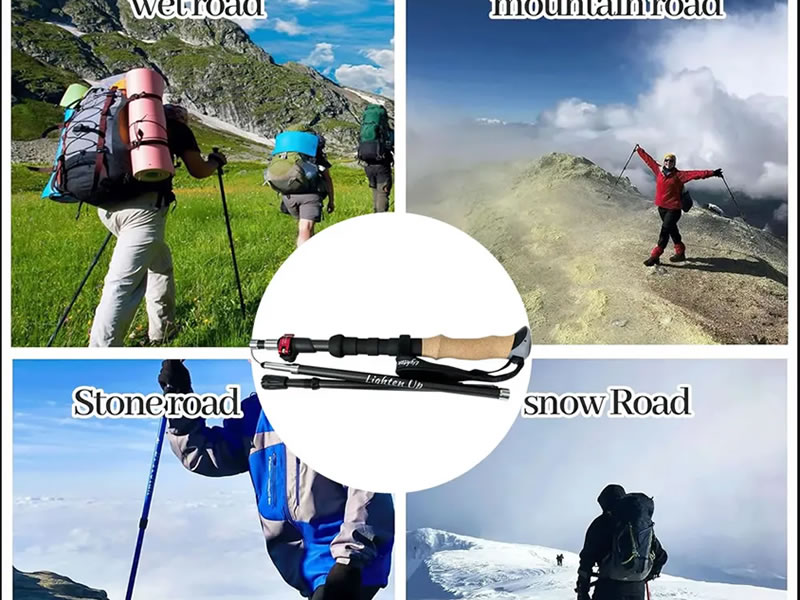
Recommended trekking pole purchase link: https://s.click.aliexpress.com/e/_c4M7OWaN
The Core of the “Difference”: Fit and Sizing
For most reputable brands, designing a “women’s” trekking pole is not about creating a fundamentally different tool. It’s about adjusting specific dimensions to better match the average physical measurements observed in their female user base. The key variations typically include:
- Grip Circumference: This is the most significant and ergonomically valid difference. Statistically, women, on average, have smaller hand dimensions than men. A “women’s” pole often features a slightly narrower grip diameter designed to fit a smaller palm more comfortably. This allows for a more secure, relaxed grip without overstraining the hand muscles, which is crucial for preventing fatigue and blisters on long hikes. However, hand size varies tremendously within all genders, making this a feature to try, not a rule to follow.
- Strap Size and Placement: Similarly, the wrist strap on a women’s model is often narrower and adjustable to a smaller circumference to sit correctly on a slimmer wrist. The strap’s anchor points on the grip may be placed slightly closer together to better align with a narrower hand.
- Length and Adjustability Range: Since average height differs between populations, women’s-specific poles are frequently sold in shorter overall lengths and may have a shorter minimum and maximum extension range. This ensures that a person of shorter stature can achieve the proper 90-degree elbow angle without the pole being at the very limit of its adjustment. Again, this is purely a height-based sizing issue.
What is NOT Different:
- Material (Aluminum/Carbon Fiber): Strength and material choices are based on intended use and price point, not gender. A woman embarking on a heavy backpacking trip needs the same durable aluminum as a man doing the same.
- Locking Mechanisms (Flick Lock/Twist Lock): Reliability and user preference here are universal.
- Shock Absorption Technology: The benefits of vibration damping are not gender-specific.
- Inherent Strength or Durability: A women’s pole from a quality brand is not “weaker”; it is built to the same rigorous standards and load ratings as the unisex or men’s counterpart.
The Critical Perspective: Individual Fit Over Gender Label
Labeling poles by gender can be a helpful starting point for average sizing, but it is far from definitive. A tall woman with larger hands may find a standard “unisex” or even a “men’s” pole fits her perfectly. Conversely, a shorter man with slender hands might prefer the grip and length of a “women’s” model. The focus should be on “fit-for-purpose” and “fit-for-body,” not “for-men” or “for-women.”
How to Choose: Your Personal Fitting Guide
Ignore the label last. Instead, follow this process:
- Grip First: This is your primary contact point. Your thumb and forefinger should overlap comfortably when you wrap your hand around the grip. If you have to stretch, it’s too large; if your fingers are crammed, it’s too small.
- Strap Second: Adjust the strap. Does it sit snugly and comfortably on your wrist without gaps or pinching? Can you transfer weight through it easily?
- Length Third: Adjust the pole. On level ground, with the tip on the floor and your hand through the strap, your elbow should form a 90-degree angle. Ensure the pole’s range accommodates this for your height, plus adjustments for uphill (shorter) and downhill (longer).
- Consider “Unisex” Models: Many of the best poles on the market are simply offered in multiple sizes (S, M, L) based on user height, which is a more rational approach than gendering.
Conclusion: Fit, Not Fiction
While trekking poles marketed for women often provide valuable ergonomic adjustments for average hand and body size, the distinction is one of tailored fit, not capability. The most important factor is how the pole feels in your hand and supports your body. Don’t let a gender label limit your choices. Try different models, prioritize grip comfort and correct length, and select the tool—regardless of its marketed gender—that makes your hike more stable, efficient, and enjoyable. Your body’s dimensions are the ultimate guide.




