




How to Use Trekking Poles Correctly for Uphill Hiking: A Technique Guide for Efficiency and Power
Mastering the use of trekking poles on uphill terrain transforms them from simple stability aids into powerful propulsion tools. Correct technique reduces fatigue in your legs, engages your upper body, and minimizes strain on your knees and hips, allowing you to climb with greater endurance and control. Here’s a comprehensive guide to the biomechanics and rhythm of efficient uphill pole use.
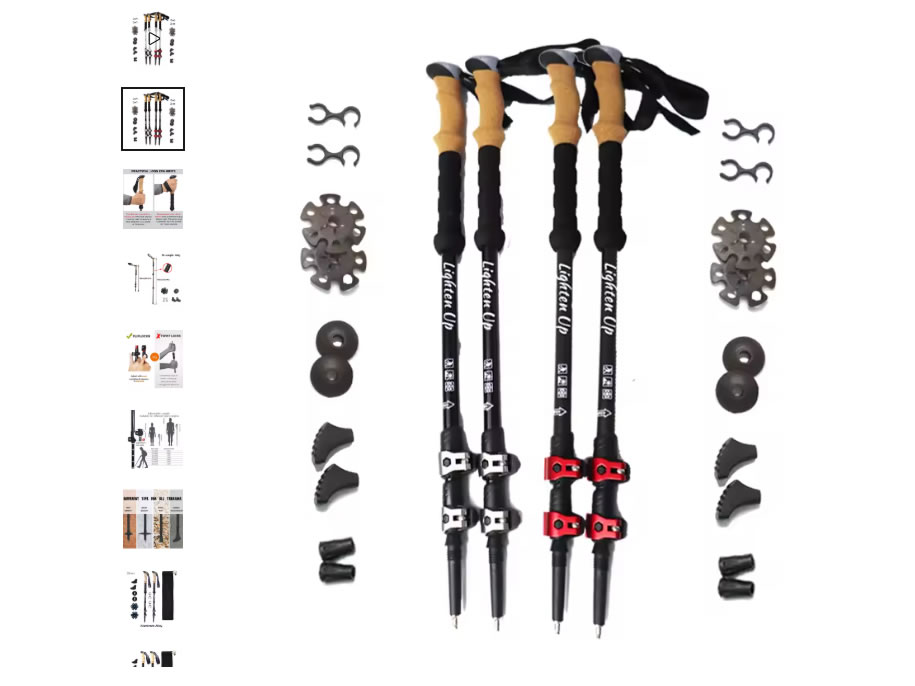
Recommended trekking pole purchase link: https://s.click.aliexpress.com/e/_c4M7OWaN
1. The Foundational Adjustment: Shorten Your Poles
Before you begin the climb, shorten each pole by 5-10 cm (2-4 inches) from your flat-ground walking length. This is crucial. On a slope, the ground is closer to your hands. A pole that is too long will force you to raise your shoulder, wasting energy and disrupting your posture. The goal is to maintain a relaxed arm with your forearm roughly parallel to the ground when the pole tip is planted behind you.
2. Posture and Grip: The Starting Position
- Stand Tall: Avoid the instinct to hunch over. Keep your torso upright and your gaze forward. Leaning too far forward compromises balance and lung capacity.
- Light Grip: Hold the grips loosely with your fingers, not in a tight fist. Your primary connection should be through the wrist strap. Slide your hand up through the strap from below, then let the strap cradle the base of your thumb. This allows you to transfer power through your palm without constant gripping, which prevents hand fatigue.
3. The Coordinated Motion: Pole Planting and Stride
The core technique is the opposite arm/leg synchronization, similar to natural walking.
- Timing: As your right foot steps forward, your left pole plants. As your left foot steps, your right pole plants.
- Planting Position: Plant the pole tip beside or slightly behind your foot that is currently on the ground (the rear foot). Do not plant it far ahead of your body, as this creates a braking effect. The ideal spot is level with or just behind your instep.
- The Power Phase: Once planted, focus on applying backward and downward pressure through the strap as your body moves forward over the planted pole. Think of it as using your arm to push the ground behind you, which propels you upward and forward. This is where your upper body contributes meaningful power.
4. Advanced Techniques for Steeper Grades
- The "Double Plant" for Short, Steep Sections: On very steep steps or "kick-ups," you can plant both poles simultaneously just in front of you and use them to pull your body upward in a powerful, coordinated move.
- Adjusting for Switchbacks: On tight, inclined turns, shorten the inside pole even more for better maneuverability and to prevent an awkward, over-reaching plant.
- Rhythm and Breath: Establish a steady rhythm that syncs with your breathing (e.g., inhale for two steps, exhale for two steps). The poles become a metronome for your climb, promoting a sustainable pace.
5. Common Mistakes to Avoid
- Planting Too Far Forward: This acts like an anchor, forcing you to pull yourself to the pole instead of pushing off from behind.
- Dragging or Shuffling Poles: Each plant should be intentional. A positive "tap" or "stick" provides reliable purchase.
- Over-Gripping: White knuckles mean you're wasting energy. Trust the strap.
- Using Arms Alone: The power should be a smooth transfer from your core and back through your arms. It’s a full-body motion.
6. The Biomechanical Benefits: Why It Works
Correct uphill pole use:
- Reduces Leg Load: It distributes the work of climbing across larger muscle groups in your shoulders, back, and core.
- Improves Stability: With two additional contact points, you significantly reduce the risk of slipping or losing balance on loose terrain.
- Enhances Circulation: The rhythmic arm motion promotes better blood flow.
- Promotes Better Posture: Encourages an upright stance, which opens the diaphragm for more efficient breathing.
In essence, uphill trekking with poles is about rhythmic, powerful pushing, not pulling. By shortening your poles, syncing your stride, and focusing on driving the ground behind you, you integrate your upper body into a unified climbing engine. Practice on moderate slopes first to build muscle memory. Soon, this technique will become second nature, turning daunting climbs into efficient, powerful, and more enjoyable ascents.




