




Do Trekking Poles Really Reduce Knee Strain? A Biomechanical Breakdown
The short answer is a resounding yes, but with a crucial caveat: when used correctly. Scientific studies and biomechanical research consistently show that trekking poles are one of the most effective tools a hiker can employ to preserve knee joint health, especially during descents—the most punishing phase of hiking for the knees. The benefits are not merely anecdotal; they are measurable and significant.
Recommended trekking pole purchase link: https://s.click.aliexpress.com/e/_c4M7OWaN
The Science of Load Transfer
The primary mechanism is load redistribution. When you walk, particularly downhill, your knees act as shock absorbers, bearing forces that can exceed 3-4 times your body weight with each step. Trekking poles intervene by creating two additional points of contact with the ground.
- During Descents: This is where poles deliver their greatest benefit. By planting a pole ahead of you on a descent, you use your arms and shoulders to control your forward momentum and lower your body weight gently. Research indicates this can reduce the compressive forces on the knees by up to 25-30%. This is not just about weight; it's about deceleration. The poles allow your upper body to act as a braking system, sparing the quadriceps and knees from eccentric overload—the primary cause of post-hike soreness and long-term wear.
- During Ascents: While the force reduction is less dramatic than on descents, poles engage the latissimus dorsi, triceps, and shoulder muscles to "push" you uphill. This directly offloads work from the quadriceps and glutes, reducing fatigue in the muscles that stabilize the knee. A less fatigued muscle is better at protecting its joint.
The Stability Factor: Preventing Acute Strain
Beyond load sharing, poles provide critical stability and proprioception. On uneven, slippery, or loose terrain, a slight slip or misstep can cause a sudden, jarring lateral movement in the knee—a common source of sprains and ligament trauma. Poles dramatically increase your base of support, providing immediate corrective feedback and preventing these micro-traumas. This preventative benefit is immense for long-term joint health.
The Correct Technique Imperative
The keyword is correctly. Improper use can negate benefits or even increase strain.
- Proper Length: On descents, lengthen your poles by 5-10 cm so you can plant them in front of you without leaning forward excessively. On ascents, shorten them to maintain efficient push-off.
- Proper Planting: The pole should be planted securely and in rhythm with the opposite foot (right pole with left foot). On descents, plant the pole ahead and to the side of your forward foot to create a stable tripod.
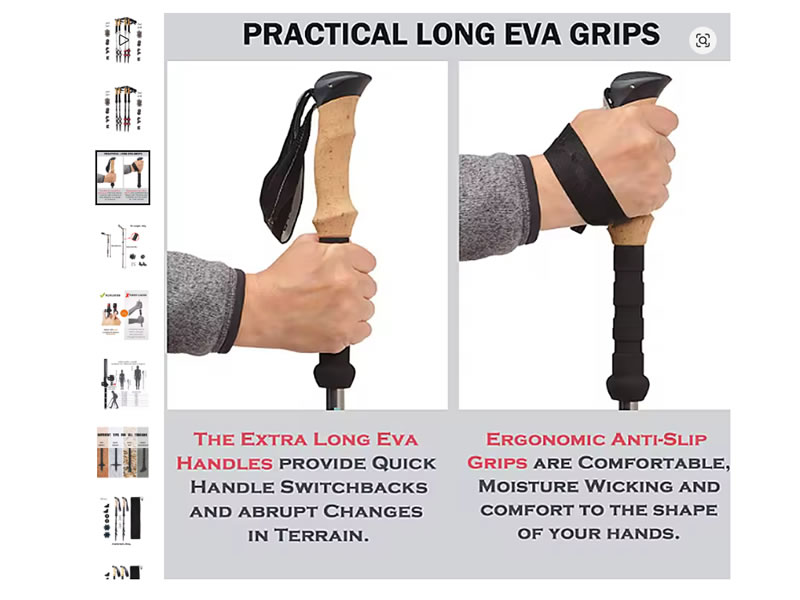
- Using the Strap: Weight should be transferred through the palm via the strap, not by gripping tightly. This engages larger muscle groups and prevents hand fatigue.
Who Benefits Most?
While all hikers gain an advantage, the knee-strain reduction is most crucial for:
- Hikers with pre-existing knee conditions (e.g., arthritis, past injuries).
- Those carrying heavy backpacks, which exponentially increase joint load.
- Anyone tackling long, steep descents (common in mountain hiking).
- Aging hikers looking to preserve joint cartilage and extend their time on the trail.
The Verdict: A Proven Tool for Joint Preservation
Trekking poles are not a gimmick. They are a biomechanical intervention that successfully shifts stress from vulnerable lower-body joints to the robust musculature of the upper body and core. The reduction in knee strain is both acute (less pain during and after the hike) and chronic (potentially slowing degenerative joint wear over years of use).
For anyone serious about hiking longevity, investing in a good pair of poles and taking the time to learn proper technique is as important as wearing supportive footwear. They are not just walking sticks; they are a portable joint-support system, proven to keep you on the trail longer and with greater comfort.




