




Proper Wrist Strap Technique for Hiking Poles?
If you’re gripping your hiking pole handles tightly for an entire trek, you’re not only wasting valuable energy but also missing the primary mechanical advantage of your gear. The wrist strap is not a mere safety loop to keep you from dropping your poles; it is the fundamental interface that transforms your poles from simple sticks into efficient levers that propel you forward. Mastering its use is the single most important technique for efficient pole use.
Recommended trekking pole purchase link: https://s.click.aliexpress.com/e/_c4M7OWaN
Why the Strap is Crucial: From Grip to Lever
The human hand and forearm are not designed for sustained, forceful gripping. A tight, constant clutch—known as a "death grip"—quickly leads to fatigue, cramping, and reduced circulation. The wrist strap elegantly solves this.
When used correctly, the strap allows you to transfer force through your skeletal structure rather than your muscles alone. You push down through the strap using the large muscles of your arm, shoulder, and back, while maintaining a relaxed, almost open hand on the handle. This turns the pole into a true extension of your arm, enabling powerful propulsion with minimal grip strength.
Step-by-Step Guide to Correct Strap Engagement
Follow this method every time you pick up your poles:
- Locate the Bottom: Identify where the strap attaches to the handle. There will be a clear top and bottom.
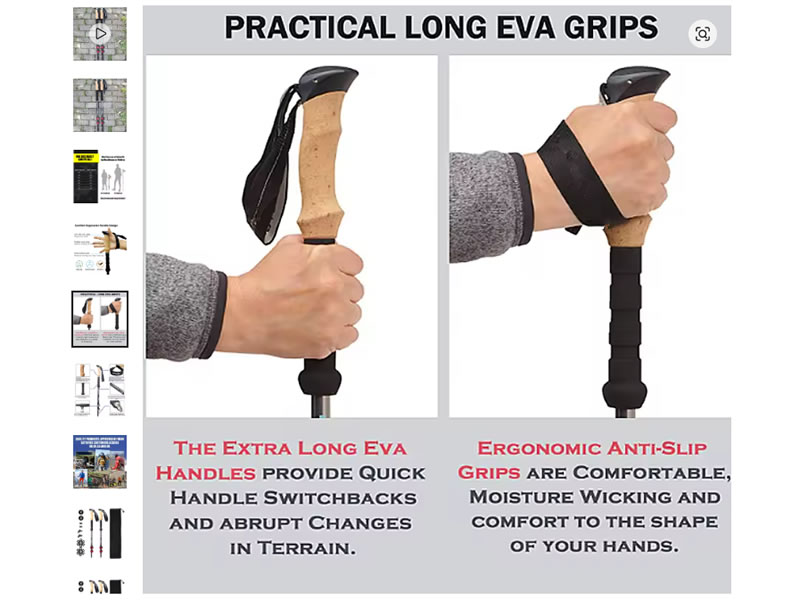
- Insert from Below: Slide your hand upwards through the strap loop from the bottom. Your palm should face the handle.
- Secure the Strap: Pull the strap across the back of your hand. The webbing should lie diagonally across your metacarpals (the back of your palm) and be secured by the base of your thumb.
- Grip Gently: Now, close your hand over the handle and the strap. Your grip should be firm enough to steer the pole but relaxed enough that you could release your fingers and still have the pole supported by the strap against your palm.
The "Handshake" Test: A quick check for correct positioning is to imagine shaking someone's hand. If you can perform that motion without the strap falling off your hand, it's positioned correctly. The pressure should be on the meaty part of your palm, not your wrist bone.
The Mechanics of Power Transfer
Once the strap is properly engaged, your poling motion changes completely:
- On the Forward Plant: As you swing the pole forward, let it dangle from the strap with a loose grip. This conserves energy.
- During the Power Phase: As you plant the tip and your body moves over it, apply downward pressure by pushing your palm down into the strap. Your hand acts as a stable hook, transferring force from your arm directly into the pole's shaft.
- On the Backswing: At the end of the stroke, you can simply open your fingers slightly, allowing the pole to pivot back naturally via the strap, ready for the next plant.
Common Mistakes and Their Consequences
- Putting the Hand Through the Top: This wraps the strap around your wrist, forcing an awkward angle and making proper force transfer impossible. It often leads to chafing and wrist strain.
- The "Death Grip": Holding on too tightly negates the strap's benefit, exhausting your forearms.
- Loose Straps: Straps that are too loose cannot provide a stable platform for pushing, causing slippage and inefficient energy transfer. Most straps have adjustable buckles—shorten them for a secure fit.
Advanced Tip: Micro-Adjustments for Terrain
- Uphill: You may slightly tighten the strap for a more direct, powerful push.
- Downhill: Ensure a secure fit, as you will rely heavily on the strap to bear weight during braking maneuvers. A loose strap here can lead to a loss of control.
- Long Descents: Periodically alter your grip slightly within the strap to prevent pressure points and maintain circulation.
Conclusion: The Strap as a Primary Tool
Rethinking the wrist strap from an afterthought to a core component of your technique will revolutionize your hiking efficiency. Proper engagement reduces fatigue in your hands and forearms by over 50%, improves power transfer for climbs and descents, and provides greater overall control. On your next hike, focus less on clutching the handle and more on pushing through the strap. You’ll discover a more rhythmic, powerful, and sustainable way to move across the trail, where your poles truly share the load.




