




The Weight Spectrum: From Ultralight to Durable Workhorse
Hiking poles generally fall into three broad weight categories, each serving a different primary purpose:
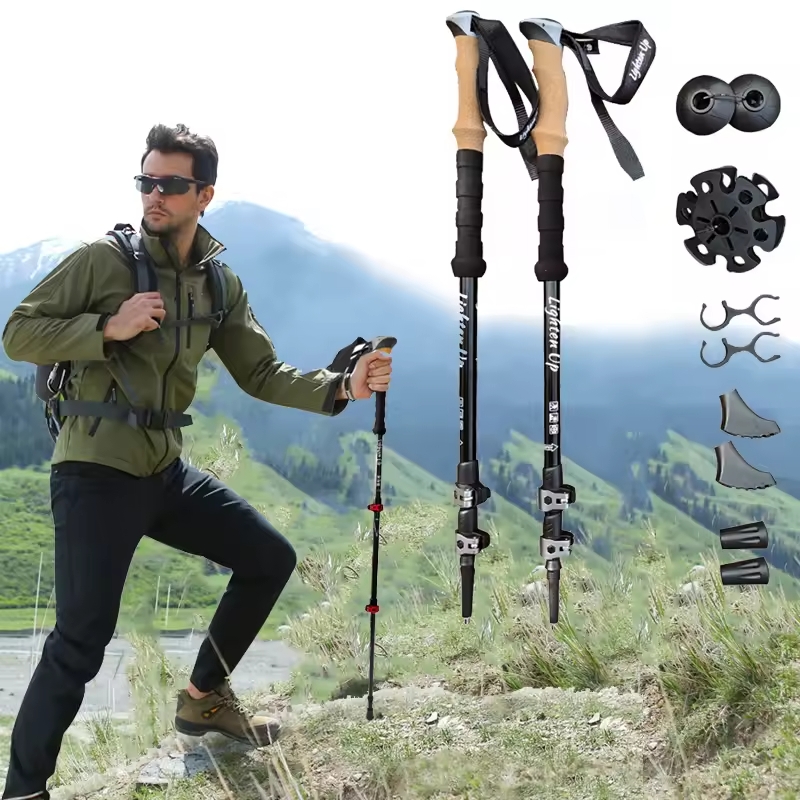
Recommended trekking pole purchase link: https://s.click.aliexpress.com/e/_c4M7OWaN
- Ultralight (Approx. 10-16 oz / 280-450g per pair):Who it's for: Thru-hikers, fastpackers, trail runners, and weight-obsessed gram counters.Typical Construction: High-modulus carbon fiber shafts, minimalist folding (Z-pole) or telescoping designs with pared-down grips and small baskets.Trade-off: These poles achieve minimal weight by using the most advanced materials and often simplifying components. They may have less margin for error against sharp, lateral impacts (like jamming in a rock crack) and command a higher price. The ideal weight here is "as light as possible without being fragile."
- Mid-Weight / Versatile (Approx. 16-20 oz / 450-570g per pair):Who it's for: The vast majority of day hikers, weekend backpackers, and general-purpose trekkers. This is the most common and recommended "ideal" range.Typical Construction: Quality 6061 or 7075 aluminum or standard carbon fiber, three-section adjustable design with standard flip locks and comfortable grips.Trade-off: This range represents the optimal balance. It offers significant weight savings over heavy-duty poles while providing ample strength for loaded backpacks and rough trail use. Poles like the Black Diamond Trail Pro (aluminum) and REI Co-op Flash Carbon live here.
- Heavy-Duty (Approx. 18-24 oz / 510-680g+ per pair):Who it's for: Off-trail adventurers, mountaineers, winter hikers/snowshoers, and those who prioritize indestructibility over every ounce.Typical Construction: Robust 7075-T6 aluminum shafts, oversized locking mechanisms, reinforced joints, and larger components.Trade-off: The added grams buy exceptional durability, impact resistance, and reliability in extreme conditions. This is the ideal weight when gear failure is not an option, and the pole is a critical safety tool.
Key Factors That Define Your Ideal Weight
- Your Hiking Discipline:Day Hiking: You have more flexibility. A mid-weight pole (16-20 oz) is perfect, but you can comfortably go lighter or slightly heavier based on feel.Backpacking: With a heavy pack, poles share significant load. Durability becomes crucial. A reliable mid-weight pole (leaning toward aluminum) is often the ideal compromise.Thru-Hiking & Fastpacking: Every ounce is magnified over thousands of steps. Ultralight poles (sub-16 oz) are ideal, provided they are still durable enough for the long haul.Off-Trail/Alpine Travel: Durability trumps all. A heavier, burly pole (18+ oz) is the ideal, safe choice.
- Shaft Material: The Primary Weight Determinant:Carbon Fiber: The choice for minimizing weight. It reduces vibration and is ideal for those seeking the lightest possible reliable pole. "Ideal" here means finding the highest-quality carbon you can afford.Aluminum (7075-T6): Slightly heavier per unit of strength than carbon, but offers superior impact resistance and a better value. The "ideal" aluminum pole is as light as it can be while still feeling solid under your weight.
- The Diminishing Returns of Ultralight: Shaving the last few ounces often comes with a disproportionate increase in cost and a potential decrease in durability. Ask yourself: Will saving 3 ounces (85g) for an extra $100 materially improve my hike, or would that investment be better spent elsewhere (e.g., a lighter tent or sleeping bag)?
The Final Verdict: A Practical Guide
Forget a single number. Follow this decision path to find your ideal weight:
- Step 1: Define Your Primary Use. Are you a weekend backpacker? A daily trail runner? An occasional day hiker?
- Step 2: Set Your Budget. This will naturally filter your material options.
- Step 3: Target a Weight Range.General Recommendation: Aim for a pair that weighs between 16 and 20 ounces (450-570g). This is the versatile sweet spot for over 80% of hikers.If you backpack with heavy loads or hike rugged terrain: Lean toward the sturdier end of that range (18-20 oz) with aluminum construction.If you prioritize speed and distance over all else: Look for quality carbon fiber poles in the 12-16 oz range.
The Most Important Test: The Hand Feel.
Specs on paper are one thing; perceived weight and balance in your hand are another. A well-balanced 18-ounce pole can feel lighter and more agile than a poorly balanced 16-ounce pole. This is why testing in a store is invaluable.
Conclusion:
The ideal weight for hiking poles is not the absolute minimum, but the minimum viable weight for your specific adventures. It is the point where you stop thinking about the poles themselves and they simply become a natural, efficient extension of your body. For most, this lies in the versatile, reliable 16-20 ounce range. By aligning weight with your actual needs, you invest in performance that enhances every mile, rather than chasing a gram count that may compromise your experience where it matters most.




