




Do Hiking Poles Scare Away Wildlife Like Snakes or Bears?
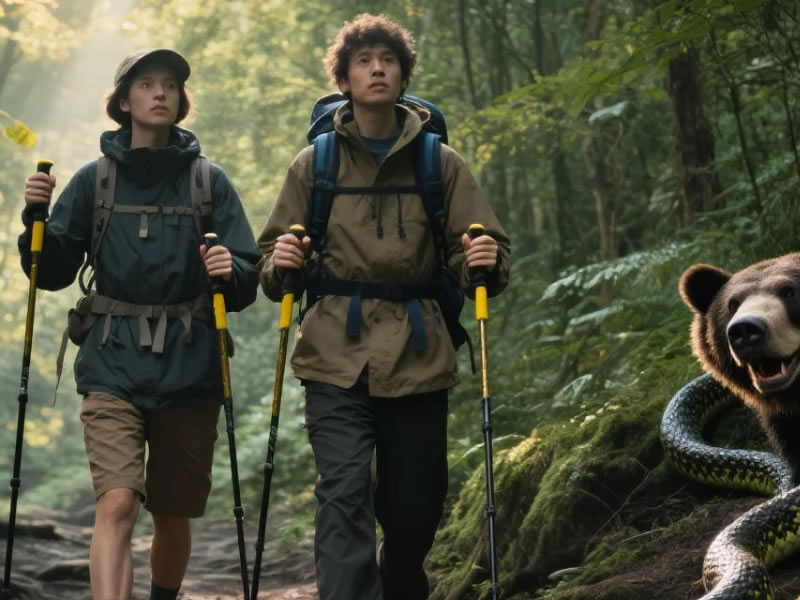
The question of whether trekking poles can act as a deterrent to wildlife is a common one among hikers, blending concerns for personal safety with curiosity about animal behavior. The answer is nuanced and differs significantly between species like snakes and large mammals like bears. While poles can have a minor influence in certain scenarios, they are not a reliable or primary wildlife deterrent and should never replace proven safety practices.
Recommended trekking pole purchase link: https://s.click.aliexpress.com/e/_c4M7OWaN
Hiking Poles and Snakes: Vibration as an Alert System
Snakes are highly attuned to ground vibrations, which they interpret through their jawbones. This is their primary way of detecting large approaching creatures.
- Do they scare snakes away? Not exactly "scare," but they can provide an early warning. The rhythmic tap-tap-tap of pole tips on the ground creates consistent vibrations that may signal your approach from farther away than your footsteps alone. This can give a snake time to retreat into cover before you arrive, potentially preventing a surprise encounter where a defensive strike is more likely.
- The Critical Caveat: This is not foolproof. A snake basking on a rock may not sense vibrations effectively, and a startled or threatened snake may still hold its ground or strike. Poles are most useful for probing areas where a snake might be concealed (e.g., tall grass, logs, rock piles) before you step or place your hand there. Their primary role is prevention through awareness, not active deterrence.
Hiking Poles and Bears: A False Sense of Security
The dynamics with bears are entirely different. Bears rely more on sight, smell, and hearing than on subtle ground vibrations.
- Do they scare bears away? Generally, no. The sound of poles is insignificant compared to human voices, clapping, or bear bells. A bear may notice the unusual sound but is unlikely to interpret it as a threat from a distance.
- The Dangerous Misconception: Some hikers wonder if waving or brandishing poles could deter a curious or aggressive bear. This is a dangerous and ineffective strategy. It may provoke a defensive charge from a surprised bear or be seen as a threat by a predatory one. Against a bear, a trekking pole is a flimsy tool compared to 800+ pounds of muscle, claws, and teeth.
- The Only Acceptable Use in Bear Country: In the extremely rare event of a defensive bluff charge, holding your ground with poles wide might make you look larger. However, your absolute priority should be using bear spray if the bear closes within range (typically 30 feet or less). The pole is irrelevant in this equation.
The Proven Hierarchy of Wildlife Safety
Hiking poles should be viewed as having a negligible, secondary effect on wildlife encounters. Your primary strategies must be:
- Make Noise: Talk, sing, or clap regularly, especially in dense brush, near streams, or on windy days where visibility is low. This alerts bears to your presence, giving them time to avoid you—the safest outcome.
- Carry and Know How to Use Bear Spray: In bear country, this is your most effective defensive tool. Keep it accessible, not buried in your pack.
- Stay Alert: Scan the trail ahead, look for signs (scat, tracks, diggings), and avoid surprising animals.
- Give Wildlife Space: Always maintain a respectful and safe distance. Use binoculars or a zoom lens for observation.
- Hike in Groups: Larger groups are noisier and appear more formidable, reducing the likelihood of most negative encounters.
The Verdict: A Tool for Stability, Not Deterrence
To summarize:
- For Snakes: Poles may provide a vibrational "heads-up" that promotes avoidance, and they are excellent for safe probing. They do not "scare" snakes in an active sense.
- For Bears and Large Mammals: Poles have no meaningful deterrent effect. Relying on them for safety is a critical mistake.
Conclusion: Hiking poles are engineered for biomechanical efficiency and joint protection, not wildlife management. Any effect on animals is passive and incidental. By all means, use your poles for stability and to probe your path, but invest your confidence in time-tested safety practices: making noise, carrying the right deterrents (like bear spray where needed), maintaining vigilance, and respecting wildlife habitat. This approach ensures both your safety and the well-being of the animals you encounter.




