




Best Hiking Poles for Heavy Loads: The Backpacker's Guide to Ultimate Support
When your backpack is laden with gear for a multi-day expedition, every piece of equipment must perform under pressure. Your hiking poles are no longer just for balance; they become critical load-bearing structures, responsible for safely transferring a significant portion of your body weight and pack weight to the ground with every step. Choosing the right poles for heavy loads (typically 30+ lb / 14+ kg packs) is an exercise in prioritizing uncompromising strength, security, and durability over minimalist weight savings. This guide details the non-negotiable features for this demanding task.
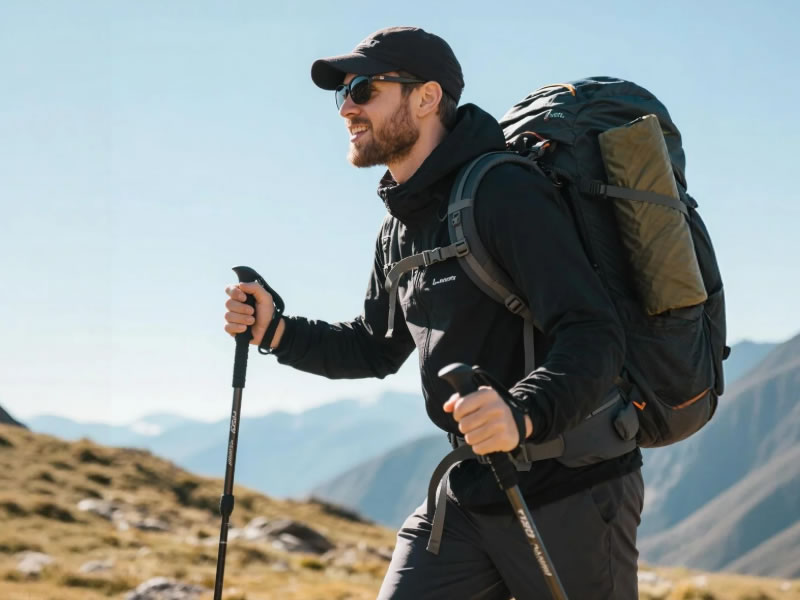
Recommended trekking pole purchase link: https://s.click.aliexpress.com/e/_c4M7OWaN
Why Heavy Loads Demand Specialized Poles
Under a heavy pack, your center of gravity shifts, descents become more punishing, and fatigue sets in faster. The right poles mitigate these effects by:
- Reducing Knee Impact by up to 25% on descents, a vital statistic when joints are already stressed.
- Providing a Stable "Outrigger" Effect to counteract the sway and pull of a heavy pack on uneven terrain.
- Enabling Upper-Body Propulsion on climbs, using your arms and back muscles to share the immense workload with your legs.
A failure under these conditions—a slipping lock or a bending shaft—is not just inconvenient; it's a safety hazard.
Critical Feature #1: The Locking Mechanism – Your Lifeline
This is the single most important feature. The lock must hold without a micron of slip under dynamic, heavy force.
- Mandatory: External Lever Locks (FlickLocks). These provide a visible, mechanical clamp that can be tightened securely and checked at a glance. Their performance is largely unaffected by dirt, moisture, or cold. They are also field-serviceable.
- Avoid: Twist-Lock Mechanisms. They are notorious for gradually slipping under heavy, constant load. Dirt and moisture exacerbate this, and they are difficult to tighten sufficiently with cold, tired hands. They represent an unacceptable point of failure for serious backpacking.
Critical Feature #2: Shaft Material – The Backbone
The choice here is clear: prioritize resilience and proven strength over cutting-edge lightness.
- Best Choice: High-Grade Aluminum (7075 Alloy). This is the gold standard for heavy-duty use. 7075 aluminum is an aerospace-grade alloy that offers an exceptional strength-to-weight ratio. Its key characteristic is predictable failure mode: if subjected to extreme force (e.g., a fall or a severe jam), it will typically bend before it snaps, often allowing for field-straightening to get you home. Its durability against abrasion from rocks and grit is superior.
- Secondary Choice: High-Modulus Carbon Fiber. While premium carbon is incredibly strong and light, its failure mode is brittle fracture—it can crack or snap suddenly under a sharp lateral impact. For a backpacker miles from civilization, this is a significant risk. If you choose carbon for its weight savings, you must select a top-tier model explicitly rated for mountaineering or heavy loads and be fastidiously careful with side impacts.
Critical Feature #3: Grip and Strap Design – The Interface of Power
You'll be transferring tremendous force through this interface.
- Grip Material: Cork remains a top choice for its natural moisture-wicking and moldable comfort. Dense foam (EVA) is also excellent. Both prevent blisters during long, forceful pushes.
- Strap Design: Wide, padded, and easily adjustable straps are essential. You must be able to push down through the strap (not just grip) to efficiently transfer weight from your skeleton to the pole, saving your hand muscles from fatigue.
Additional Load-Bearing Considerations
- Weight Rating: Check the manufacturer's specifications. Quality heavy-load poles often have a rated capacity of 300+ pounds.
- Shaft Diameter: Look for poles with a slightly larger shaft diameter (e.g., 16-18mm at the thickest point). This increases lateral rigidity.
- Minimal Sections: A 3-section pole offers a good balance of packability and strength. 2-section poles are even stronger (fewer joints) but are less packable. Avoid overly complex multi-section poles for primary heavy-load use.
- No Shock Absorption (Typically): While personal preference varies, many seasoned backpackers avoid shock-absorbing ("anti-shock") poles for heavy loads. The spring mechanism can create a slight lag or "mushiness" in the plant when you need immediate, solid feedback from the ground, especially on technical terrain.
Top Recommendations and Philosophy
Brands like LEKI, Black Diamond, and Komperdell excel in this category with models built for mountain guides and expedition use.
- Expedition Workhorse: Black Diamond Expedition 3 or LEKI Sherpa XL. These are burly, reliable, and time-tested.
- Premium Performance: LEKI Khumbu or Black Diamond Trail Pro (in aluminum). These offer refined features with heavy-duty construction.
Philosophy: When carrying a heavy load, your poles are part of your safety system. Invest accordingly. The extra few ounces of a bomb-proof aluminum pole are meaningless compared to the security and support they provide over a 10-day trek.
Proper Technique Under Load
- Lengthen for Descents: Increase pole length significantly to create a forward brace, allowing you to lower your body and pack weight controllably.
- Use the Strap Correctly: Always employ the proper strap technique to let your skeletal structure bear the load.
- Double-Plant on Steep/Tricky Sections: For maximum security, plant both poles before moving your feet.
Conclusion: The Foundation of Safe Load Carriage
The best hiking poles for heavy loads are defined by their fortitude and reliability. By selecting poles built with 7075 aluminum, fail-safe lever locks, and ergonomic grips, you build a foundation of trust. These poles become unwavering partners, reliably translating your effort into forward motion and stability, mile after mile, under the formidable weight of your expedition kit. In the realm of backpacking, where gear failure carries real consequence, this is one area where compromise is not an option. Choose strength, and hike with confidence.




