




How to Use Walking Poles for Nordic Walking? The Complete Guide to Full‑Body Fitness
Nordic walking is not merely walking with poles—it is a specific, highly efficient fitness technique that engages approximately 90% of the body's muscles, burns up to 46% more calories than conventional walking, and reduces stress on joints. Originating as a summer training method for cross‑country skiers, it has evolved into a worldwide fitness phenomenon. This guide provides a comprehensive, step‑by‑step methodology for mastering Nordic walking technique, from the basic stride to advanced refinements.
Recommended trekking pole purchase link: https://s.click.aliexpress.com/e/_c4M7OWaN
The Core Philosophy: Walking as a Full‑Body Workout
Unlike recreational hiking with poles, where the primary goals are stability and joint protection, Nordic walking is a fitness activity. The objective is to deliberately engage the upper body to propel yourself forward, creating a continuous, flowing motion that works arms, shoulders, back, core, and legs in coordinated synergy.
Key distinctions from recreational pole walking:
- Poles are shorter (sized to height × 0.68, not 90° elbow).
- Grips are angled (typically 15°) to facilitate rearward push.
- Technique emphasizes hand opening at the end of each stride.
- The goal is propulsion, not just support.
Part I: Equipment – The Right Tools for Nordic Walking
Before mastering technique, ensure you have appropriate equipment.
Poles
- Fixed‑length poles are preferred over adjustable. They are lighter, stiffer, and provide consistent ergonomics.
- Length formula: Height (cm) × 0.68. This places your elbow at approximately 90° when the tip is on the ground behind you.
- Angled grips (typically 15°) allow a neutral wrist position during rearward push.
- Detachable strap systems (e.g., LEKI Trigger Shark) are common, allowing you to release the pole easily.
Tips
- Rubber "asphalt feet" for pavement walking.
- Carbide tips (exposed by removing rubber feet) for soft trails.
- Rolling tips (optional) for advanced technique on hard surfaces.
Part II: The Fundamental Technique – Diagonal Stride
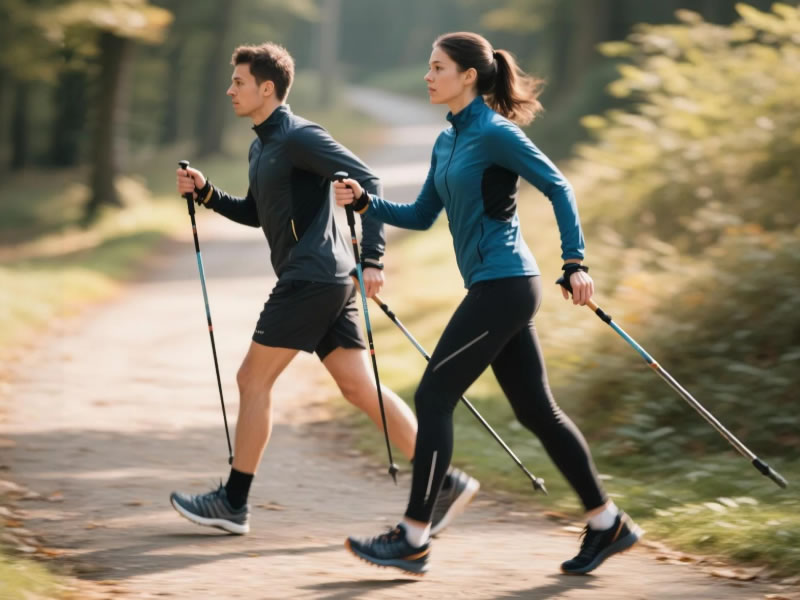
Nordic walking uses the same contralateral (diagonal) stride as natural walking: right pole with left foot, left pole with right foot.
Phase 1: The Plant and Push
- As your left foot swings forward, plant the right pole tip at a point beside or slightly behind your trailing (right) foot. Do not plant ahead of your body.
- Engage the strap correctly. Your hand should be inserted upward from below, with the strap across the back of your wrist.
- Push down and back through the strap, driving the pole rearward.
- Extend your arm fully behind you at the end of the push, engaging your triceps, lats, and shoulder muscles.
Phase 2: The Hand Opening
This is the signature element of Nordic walking.
- As your arm reaches full extension behind you, consciously open your hand. Release your grip completely.
- The pole remains attached via the strap, swinging forward in a relaxed arc.
- Your open hand allows the pole to "float" into position for the next plant without gripping.
Why hand opening matters:
- Prevents "death grip" and hand fatigue.
- Allows the pole to swing naturally, conserving energy.
- Ensures the push comes from the strap, not the grip.
Phase 3: The Recovery and Next Plant
- As your arm swings forward, your hand naturally closes around the grip just before the next plant.
- The cycle repeats with the opposite side.
Part III: Full Body Engagement
Nordic walking is not just about arms and legs—it is a coordinated whole‑body movement.
Core
- Your abdominal and back muscles work continuously to transfer power between upper and lower body.
- Maintain a slight, natural tension in your core throughout the stride.
Shoulders and Back
- Your shoulder blades retract slightly during the forward swing and protract during the rearward push.
- Your latissimus dorsi (back muscles) contribute significantly to the pushing motion.
Hips and Glutes
- Hip extension is exaggerated compared to normal walking, driven by the rearward pole push.
- Glutes activate strongly at the end of each stride.
Legs
- A natural, comfortable stride length. Do not overstride.
- Push off from your rear foot as the pole pushes rearward.
Part IV: Posture and Gaze
- Stand tall. Chest open, shoulders back and relaxed, head level.
- Look ahead, not down. Your poles are tools; trust them to find the ground.
- Avoid leaning forward at the waist. Your torso should remain upright, with a slight natural forward lean from the ankles.
Part V: Common Mistakes and Corrections
| Mistake | What It Looks Like | Consequence | Correction |
|---|---|---|---|
| Planting ahead of body | Pole tip in front of leading foot. | Creates braking force; reduces propulsion. | Plant beside or behind trailing foot. |
| Never opening the hand | Constant grip on handles. | Hand fatigue; inefficient energy transfer. | Consciously open hand at end of push. |
| Same‑side rhythm | Right pole with right foot. | Awkward, inefficient, reduces core engagement. | Practice opposite arm/leg. |
| Stiff arms | Arms locked, no elbow flexion. | Disrupts rhythm; increases fatigue. | Allow natural elbow bend (10–20°). |
| Hunched posture | Shoulders rounded, head down. | Reduced lung capacity; back strain. | Stand tall; chest open. |
| Dragging poles | Poles trail behind, not actively pushed. | No propulsion; wasted energy. | Focus on active rearward push. |
| Overstriding | Excessively long steps. | Reduces efficiency; increases impact. | Maintain natural stride length. |
| Wrong pole length | Elbow angle incorrect at plant. | Compromised biomechanics; reduced benefit. | Verify length formula (height × 0.68). |
Part VI: Adapting to Terrain
Uphill
- Shorten your stride slightly.
- Emphasize a more aggressive rearward push.
- Keep torso upright; avoid leaning into the hill.
Downhill
- Lengthen your stride slightly.
- Allow the poles to provide braking by planting slightly ahead.
- Maintain upright posture; do not lean back.
Uneven Terrain
- Shorten your stride.
- Focus on precise tip placement.
- May revert to recreational pole technique (less hand opening) for stability.
Part VII: Developing Rhythm and Cadence
- Aim for a quick, light cadence. Short, rapid plants are more efficient than long, slow ones.
- Count "1‑2, 1‑2" to establish rhythm.
- Practice on flat, even terrain until the motion becomes automatic.
- Listen to your poles. A smooth, rhythmic "swish" indicates good technique; a jerky, irregular sound suggests errors.
Part VIII: Benefits of Proper Technique
When performed correctly, Nordic walking:
- Increases calorie burn by 20–46% compared to conventional walking.
- Reduces perceived exertion – you walk faster while feeling like you are working less.
- Engages 90% of muscles – a genuine full‑body workout.
- Improves posture and core strength.
- Reduces joint impact compared to running or even brisk walking.
- Provides cardiovascular benefits comparable to jogging, with less stress.
Part IX: Progression – From Beginner to Advanced
Beginner (First 1–3 sessions)
- Focus on opposite arm/leg rhythm.
- Practice strap engagement.
- Walk on flat, even terrain.
- Do not worry about hand opening yet.
Intermediate (Next 3–5 sessions)
- Introduce conscious hand opening at end of push.
- Begin to feel the rearward push engaging back muscles.
- Experiment with slightly faster cadence.
Advanced (Ongoing)
- Refine timing and fluidity.
- Use poles on varied terrain.
- Incorporate intervals (fast walking with poles).
- Consider workshops or coaching for fine‑tuning.
Part X: Equipment Maintenance
- Clean poles after use, especially if walked on gritty pavement.
- Inspect rubber feet regularly; replace when worn.
- Check strap attachments for wear.
- Lubricate locking mechanisms (if adjustable) occasionally.
Summary: Nordic Walking Technique at a Glance
| Element | Correct Technique |
|---|---|
| Pole length | Height (cm) × 0.68 (fixed length preferred). |
| Strap use | Hand up from below; push through strap. |
| Rhythm | Opposite arm/leg (right pole/left foot). |
| Plant position | Beside or behind trailing foot. |
| Push | Down and back; full arm extension. |
| Hand | Open at end of push; relax. |
| Posture | Upright, chest open, look ahead. |
| Cadence | Quick, light, rhythmic. |
Conclusion: From Walking to Full‑Body Fitness
Nordic walking transforms a simple, accessible activity into a sophisticated, highly efficient fitness modality. The difference between recreational pole use and true Nordic walking is not in the equipment—it is in the intent and technique. When you master the diagonal stride, the rearward push, and the hand opening, you unlock a workout that engages your entire body, burns more calories, and leaves you feeling invigorated rather than fatigued.
Start slowly. Focus on rhythm. Let your hands open. Feel the burn in your arms and back.
Within a few sessions, the motion will become second nature. You will walk faster, work harder, and enjoy it more—all because you learned to use your poles correctly.
Your body is ready. Your poles are waiting. Let's walk.




