




Trekking Poles for archaeological site surveying?
Archaeological site surveying often involves walking long distances over rough, uneven terrain – plowed fields, rocky slopes, dense brush, or eroded landscapes – while carrying equipment such as total stations, GPS receivers, notebooks, and cameras. Surveyors may spend hours on their feet, often bending or kneeling to examine artifacts or soil features. In these demanding conditions, trekking poles are not just a convenience; they become essential tools for stability, fatigue reduction, and even on‑site measurement. However, not every pole is suitable for the unique needs of archaeological fieldwork. This article explains what archaeologists should look for in trekking poles, recommended models, and practical ways to use poles during survey.
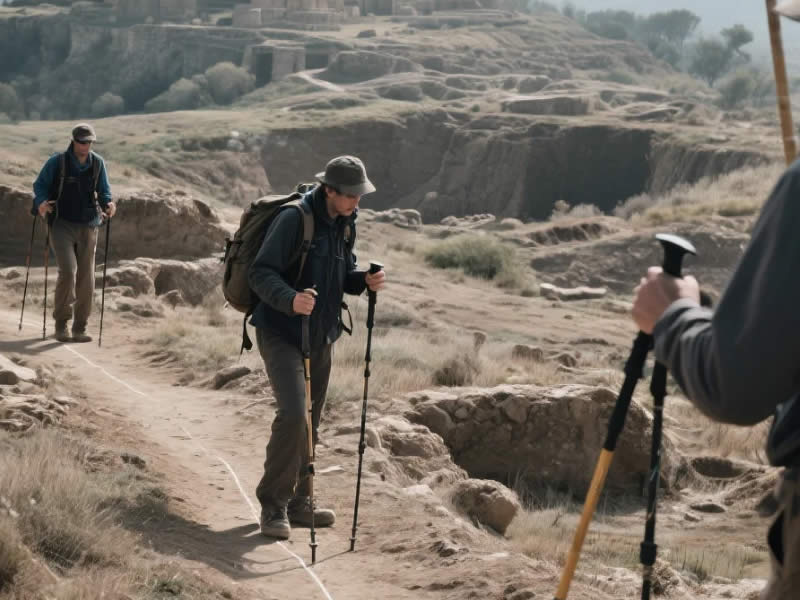
Recommended trekking pole purchase link: https://s.click.aliexpress.com/e/_c4M7OWaN
Why Archaeologists Need Specialized Poles
Archaeological survey differs from recreational hiking in several key ways:
- Repetitive stooping and kneeling – Surveyors constantly bend to pick up sherds, examine soil profiles, or record features. Poles help you push yourself back up, saving knee and back strain.
- Heavy, awkward loads – Carrying a backpack with survey gear, water, and samples often exceeds 15–20 kg (33–44 lbs). Poles distribute weight and improve balance.
- Soft or unstable ground – Plowed fields, sand dunes, and marsh edges are common. Poles prevent ankle twists and provide probing points.
- Dust and dirt – Mechanisms must resist grit. Twist locks fail quickly in dusty environments.
- Quiet operation – In remote or sensitive areas, loud clicking poles can disturb wildlife or fellow team members.
- Multi‑functionality – Poles can serve as measuring rods, antenna masts, or emergency splints.
Key Features for Archaeological Survey Poles
1. Aluminum Shafts – Carbon Is Too Brittle
Archaeologists may use poles to probe soil for buried features, or to steady themselves on rocky outcrops. Carbon fiber poles can snap under lateral stress or when jammed into hard ground. 7075 aluminum offers the best strength‑to‑weight ratio and will bend rather than break. A bent pole can often be straightened in the field.
2. Flip Locks (Lever Locks) – Not Twist Locks
Dust and dirt are enemies of twist locks. Flip locks (lever locks) are easy to clean, provide a visual lock indication, and can be tightened with a simple screwdriver. For archaeological work in dusty conditions, flip locks are non‑negotiable.
3. Replaceable Carbide Tips
When probing soil or walking on rocky surfaces, carbide tips wear down. Poles with user‑replaceable carbide tips (screw‑in or press‑fit) allow you to extend the pole’s life. Non‑replaceable tips mean the whole pole is trash once the tip rounds.
4. Rubber Tips for Sensitive Surfaces
On paved roads, building foundations, or delicate archaeological floors (e.g., mosaic tiles), carbide tips can cause damage. Rubber tip covers (paws) protect both the surface and the tip. Keep a set in your field pack.
5. Cork Grips for Long‑Term Comfort
Archaeologists may walk for 6–8 hours a day. Cork grips are comfortable, wick sweat, and resist odor. Foam grips wear out; rubber becomes sticky. Cork is the professional choice.
6. Clear Centimeter Markings
Many trekking poles have length markings (in centimeters) printed on the shaft. These can be used as an improvised measuring rod – for estimating artifact scatter dimensions, recording soil layer depths, or setting up a 1x1 meter test pit. Look for poles with high‑contrast, durable markings.
7. Interchangeable Baskets
In soft sand or plowed soil, standard baskets will sink. Larger “mud baskets” or “power baskets” prevent the pole from disappearing into the ground. Choose poles with easily swappable baskets.
8. Strong, Padded Wrist Straps
Straps should be wide, padded, and adjustable over gloves. Quick‑release systems (e.g., Leki Trigger) allow you to detach the pole instantly – useful when you need both hands for a camera or a trowel.
9. Bright Colors for Visibility
Dropped poles in tall grass or brush can be hard to find. Bright orange, red, or yellow poles are easy to spot. They can also be used as visual markers for transect lines.
Recommended Poles for Archaeological Survey
1. Leki Makalu (7075 Aluminum, Cork Grip)
- Why it’s ideal: Bombproof construction, metal flip locks, replaceable everything. The extended cork grip with foam choke allows comfortable choking down. Centimeter markings are clear and durable. Used by professional archaeologists in the field.
- Weight: ~260g per pole
- Price: $120–160
2. Black Diamond Trail Ergo Cork
- Why it’s ideal: FlickLock is legendary for reliability – easy to clean and adjust. Ergonomic cork grip reduces wrist fatigue. Solid aluminum shaft.
- Weight: ~270g
- Price: $130–150
3. Komperdell Expedition Cork
- Why it’s ideal: 7075 aluminum, Power Lock 2.0 metal levers, large power baskets included. Very robust.
- Weight: ~280g
- Price: $140–180
4. Cascade Mountain Tech Aluminum (Budget Option)
- Why it’s ideal: Affordable for field schools or large survey teams. 6061 aluminum, flip locks, cork grips, replaceable tips. Good enough for moderate use.
- Weight: ~240g
- Price: $50–70
Practical Uses of Trekking Poles in Archaeology
- Measuring stick: Use the pole’s centimeter markings to quickly measure artifact scatter diameter, trench depth, or distance between features. Extend the pole to its full length for a 1.35 m measuring rod.
- Soil probe: The carbide tip can be gently pushed into soil to check for buried cultural layers (avoid using as a heavy probe that might damage artifacts).
- Tripod leg: Use three poles to create an improvised tripod for a camera or a total station prism.
- Trowel rest: When kneeling, plant a pole to lean on while troweling, reducing back strain.
- Transect marker: Brightly colored poles can mark the corners of a survey grid.
- Emergency splint: In case of injury, poles can immobilize a fractured limb.
Field Maintenance and Spare Parts
Archaeological fieldwork is tough on gear. Carry:
- 2 spare carbide tips per pole
- 4 spare rubber tip covers
- Small Phillips screwdriver (for flip lock screws)
- Zip ties and duct tape (temporary repairs)
- Silicone lubricant (for shafts – never on locks)
After each day, rinse mud and dust from locks, wipe shafts, and let poles dry before collapsing. Tighten any loose flip lock screws.
Noise Considerations
In quiet rural or natural settings, the click of carbide tips can be distracting to team members or may alert landowners. Use rubber tips whenever possible. If you need to probe soil, remove the rubber tip briefly, then replace.
Final Thoughts
Archaeological site surveying demands trekking poles that are durable, dust‑resistant, comfortable, and multi‑functional. Aluminum shafts, flip locks, replaceable carbide tips, cork grips, and clear centimeter markings are essential. The Leki Makalu and Black Diamond Trail Ergo are top choices for professional archaeologists and field schools. For budget‑conscious projects, Cascade Mountain Tech poles offer acceptable performance. Invest in spare tips and a small repair kit. With the right poles, you’ll hike farther, bend less, and have a handy measuring tool always at your side – leaving you more energy for the discovery that matters. Happy surveying.




