




What Are Walking Poles Used For? The Complete Guide to Their Purpose and Benefits
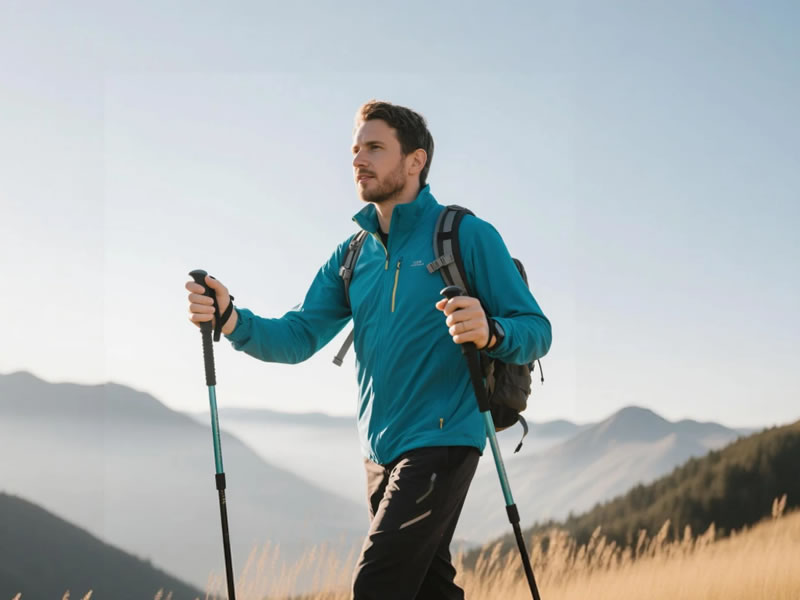
Walking poles—also commonly called hiking poles, trekking poles, or Nordic walking poles—are far more than simple sticks. They are sophisticated, biomechanical tools designed to enhance nearly every aspect of human locomotion over uneven terrain. Yet many newcomers, and even some experienced hikers, underestimate their full range of utility. This comprehensive guide explores the many purposes of walking poles, from the obvious to the overlooked, and explains why they have become essential equipment for millions of outdoor enthusiasts worldwide.
Recommended trekking pole purchase link: https://s.click.aliexpress.com/e/_c4M7OWaN
1. Joint Protection and Impact Reduction
This is the most scientifically validated and clinically significant use of walking poles.
The Problem: When you walk downhill, your knees and hips absorb forces equivalent to 3 to 7 times your body weight with every step. This repetitive, high-impact loading is the primary cause of patellofemoral pain syndrome, iliotibial band friction, and the aggravation of osteoarthritis.
The Solution: Walking poles act as shock-absorbing outriggers. By planting a pole ahead of your body and transferring weight onto it, you redirect a significant portion of that impact force away from your lower joints and into your upper body. Research indicates this can reduce compressive knee loads by up to 25% on descents. For a hiker with a 30-pound pack, this represents tons of cumulative joint stress saved over a single day of hiking.
Who Benefits: Anyone with knee pain, previous joint injuries, arthritis, or simply a desire to preserve their long-term joint health.
2. Stability and Fall Prevention
Human bipedal balance is inherently precarious, especially on uneven, slippery, or sloping terrain.
The Mechanism: Walking poles expand your base of support from two points (your feet) to three or four points (two feet plus one or two poles). This geometric transformation creates a tripod or quadpod effect that dramatically enhances lateral and forward/backward stability.
Critical Applications:
- Stream Crossings: Poles provide essential three-point contact on slippery, submerged rocks with unseen footing.
- Loose Scree and Talus: They allow you to test the stability of a rock before committing your weight.
- Icy or Snow-Covered Trails: A well-planted pole can be the difference between a controlled traverse and a dangerous fall.
- Sidehill Traverses: A downhill pole acts as a critical outrigger, preventing gravity from pulling you off-camber.
3. Propulsion and Energy Efficiency
Walking poles are not passive supports; they are active propulsion tools.
The Technique: When a pole is planted and pushed against, it generates forward thrust. This action recruits your upper body musculature—lats, triceps, pectorals, and deltoids—to assist your legs in moving your body forward and upward.
The Benefit: This shared workload reduces the perceived exertion of climbing steep grades and allows you to maintain a faster pace with less leg fatigue. Experienced users report that poles make them feel as though they have "an extra gear" on long, sustained ascents.
The Evidence: Studies of Nordic walking, which emphasizes aggressive pole push-off, demonstrate significant increases in energy expenditure (calorie burn) with no increase in perceived effort.
4. Probing and Terrain Assessment
Your poles are your eyes beneath the surface.
- Snow Depth and Stability: Before each step in deep snow, a pole probe reveals whether you are about to post-hole up to your thigh or whether a firm subsurface exists.
- Mud and Bog: A jab with your pole identifies hidden bottomless pits before you commit your weight.
- Stream Depth and Current: Poles measure water depth and allow you to feel the strength of the current before you step in.
- Hidden Obstacles: Roots, rocks, and holes concealed by leaf litter or tall grass are revealed by a deliberate pole plant.
5. Load Support and Backpacking Assistance
When carrying a heavy backpack, your center of gravity shifts upward and backward. This increases the demand on your lower back and legs while reducing your inherent stability.
Walking poles counteract this by:
- Acting as counter-levers that help you maintain an upright posture.
- Providing additional points of support to manage the lateral sway of a heavy load.
- Assisting in the powerful "hoist" motion required to lift a heavy pack up steep steps or over obstacles.
For thru-hikers and expedition backpackers, poles are non-negotiable equipment.
6. Uphill Power Generation
On steep ascents, poles shift from balancing tools to climbing aids.
- Standard Technique: A firm plant and push-off from a position behind your body adds propulsive force to each step.
- Double Plant: On very steep grades, planting both poles simultaneously and pulling down with both arms allows you to "hoist" your body upward—a dramatically more efficient method than leg power alone.
7. Posture and Spinal Alignment
Without poles, many hikers adopt a defensive, hunched posture on descents and a collapsed, forward-leaning posture on flats. Both positions strain the cervical and lumbar spine.
Poles encourage:
- An upright torso on climbs, optimizing lung expansion.
- A neutral spine on descents, as you lean slightly into your planted poles rather than leaning back against gravity.
- Reduced neck strain, as you spend less time staring fixedly at your feet.
8. Wildlife and Vegetation Management
While not their primary design purpose, poles serve as excellent tools for:
- Clearing spider webs across the trail.
- Parting tall grass or overgrown brush to pass through without getting soaked with dew.
- Creating distance between yourself and unexpected wildlife encounters (though never approach animals).
9. Emergency and Safety Uses
Experienced backcountry travelers recognize their poles as multi-tool safety devices:
- Tent Pitch: Many ultralight tarps and trekking-pole tents rely on poles as the primary structural support.
- Splint Material: In a wilderness first aid scenario, a pole can serve as an emergency splint for a fractured limb.
- Signaling Device: A raised pole with a brightly colored jacket attached increases visibility for search and rescue.
- Self-Arrest: In snow travel, poles can assist (but not replace an ice axe) in arresting a slide.
10. Psychological Confidence and Endurance
This benefit is intangible but profoundly real. The presence of poles reduces the fear of falling, especially on exposed terrain. This psychological safety net allows hikers to move more fluidly, maintain better posture, and focus on the scenery rather than obsessing over each foot placement. Reduced anxiety translates directly to reduced muscle tension and delayed fatigue.
Summary Table: Walking Pole Uses at a Glance
| Primary Function | Key Benefit | Best For |
|---|---|---|
| Joint Protection | Reduces knee/hip impact by up to 25% | Descending, backpackers, seniors, injury recovery |
| Stability | Prevents slips and falls | Uneven terrain, stream crossings, ice, snow |
| Propulsion | Increases speed and efficiency | Climbing, long-distance hiking, Nordic walking |
| Probing | Reveals hidden hazards | Deep snow, mud, water crossings |
| Load Support | Manages heavy pack weight | Backpacking, expedition travel |
| Posture | Maintains neutral spine | All hikers, especially those with back pain |
| Emergency | Shelters, splints, signaling | Backcountry travelers, ultralight campers |
Conclusion: An Indispensable Tool for Modern Hiking
Walking poles are not a crutch for the weak or a concession to age. They are a performance-enhancing, injury-preventing, efficiency-maximizing tool for hikers of all ages and abilities. Their uses span from the biomechanical (reducing joint impact) to the practical (probing snow depth) to the psychological (building trail confidence). Whether you are a weekend day-hiker, a thru-hiker attempting a 2,000-mile trek, or a senior seeking to maintain mobility on the trails you love, walking poles are one of the most versatile and valuable investments you can make in your outdoor experience. They do not make you weaker; they make you capable of going further, safer, and with greater enjoyment.




