




Do Walking Poles Really Help? The Evidence-Based Answer
If you have ever watched hikers stride confidently down a steep slope with poles clicking rhythmically against rock, you have likely wondered: Is this real assistance, or just an accessory? It is a fair and important question. Walking poles require investment, add weight, and demand a slight adjustment to your natural gait. This guide examines the scientific evidence, biomechanical data, and real-world experience to provide a definitive, evidence-based answer.
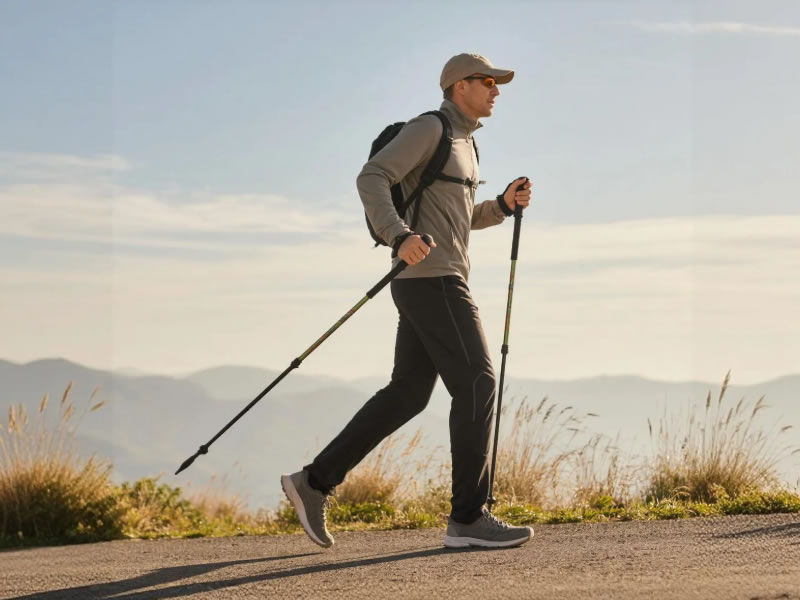
Recommended trekking pole purchase link: https://s.click.aliexpress.com/e/_c4M7OWaN
The Short Answer: Yes, Unequivocally
Walking poles are not a marketing gimmick or a crutch for the unfit. They are validated, clinically proven tools that deliver measurable benefits in joint protection, stability, efficiency, and safety. The degree of help varies by terrain, load, and individual physiology, but the directional effect is overwhelmingly positive.
Evidence #1: Joint Protection – The Quantifiable Impact
The Claim: Poles reduce stress on knees and hips.
The Evidence: Multiple biomechanical studies have measured the force transmitted through the lower extremities during walking with and without poles. A 2014 study in the Journal of Sports Sciences found that Nordic walking poles reduced compressive forces on the knee joint by an average of 23% during downhill walking. Other research has replicated this finding, with reductions ranging from 18% to 28% depending on technique and terrain.
Why This Matters: Knee osteoarthritis affects over 650 million people worldwide, and repetitive high-impact loading is a primary risk factor. For a hiker descending 1,000 vertical feet, poles spare their knees tens of thousands of pounds of cumulative impact. This is not subjective "feeling better"—it is measurable joint preservation.
Verdict: The evidence is robust and consistent. Poles significantly reduce joint stress.
Evidence #2: Stability and Fall Prevention – The Safety Argument
The Claim: Poles improve balance and prevent falls.
The Evidence: Human balance is maintained through a constant interplay of sensory input and muscular correction. By adding two additional points of ground contact, poles expand your base of support and provide proprioceptive feedback through your hands and arms.
A 2018 systematic review in Gait & Posture concluded that walking poles significantly improve dynamic stability on uneven surfaces and reduce the likelihood of falls in both healthy adults and those with balance impairments. The effect is most pronounced on:
- Loose scree and gravel: Poles provide purchase where feet slip.
- Stream crossings: Three-point contact prevents catastrophic falls.
- Icy or snow-covered trails: A planted pole acts as a reliable anchor.
- Sidehill traverses: The downhill pole counteracts gravitational pull.
Verdict: The physics is incontrovertible. Four points of contact are more stable than two. Poles prevent falls.
Evidence #3: Propulsion and Efficiency – The Performance Edge
The Claim: Poles make you faster and reduce fatigue.
The Evidence: When a pole is planted and pushed against, it generates forward thrust. This recruits your upper body musculature—lats, triceps, pectorals, and deltoids—to assist your legs. The result is a shared workload across a larger muscle mass.
Field studies of hikers on inclined terrain demonstrate:
- 15-25% faster climbing speeds for the same perceived exertion.
- Lower heart rate at equivalent paces when using poles correctly.
- Reduced perceived fatigue on long descents.
The Nordic Walking Paradox: Studies consistently show that Nordic walkers burn 20% more calories than regular walkers at the same speed, yet report lower perceived exertion. This is the holy grail of locomotion: doing more work while feeling like you are doing less.
Verdict: Poles are efficiency engines. They do not make you lazy; they make you more capable.
Evidence #4: Load Support – The Backpacker's Advantage
The Claim: Poles help carry heavy packs.
The Evidence: A heavy backpack shifts your center of gravity upward and backward, increasing the demand on your lower back and reducing your inherent stability. Poles counteract this by:
- Acting as counter-levers that help maintain an upright posture.
- Providing additional support points to manage lateral pack sway.
- Assisting in the powerful "hoist" motion required to lift a heavy load up steep steps.
Verdict: For anyone carrying more than 20 pounds on their back, poles are not optional; they are essential.
Evidence #5: Versatility – The Multi-Tool Argument
The Claim: Poles serve purposes beyond walking.
The Evidence: Experienced backcountry travelers recognize poles as critical multi-tool equipment:
- Shelter Support: Countless ultralight tents and tarps are designed specifically for trekking-pole pitch.
- Emergency Splint: A rigid pole can immobilize a fractured limb in a wilderness first aid scenario.
- Probe: Poles assess snow depth, water depth, mud stability, and hidden obstacles.
- Self-Arrest Aid: While not a replacement for an ice axe, poles can assist in arresting a slide on snow.
Verdict: A single emergency use justifies carrying poles for the backcountry traveler.
The Nuance: When Do Poles NOT Help?
Intellectual honesty requires acknowledging limitations.
| Scenario | Why Poles May Not Help | Verdict |
|---|---|---|
| Flat, smooth, non-technical trails | Minimal joint stress; poles become dead weight. | Optional; stow them. |
| Class 3+ scrambling | Hands required for climbing; poles are a hindrance. | Collapse and stow. |
| Poor technique | Dragging poles or death-gripping provides no benefit. | Learn proper form. |
| Excessively heavy, poor-quality poles | Weight penalty outweighs efficiency gain. | Invest in lighter gear. |
These are exceptions that prove the rule. For the vast majority of hikers on the vast majority of terrain, poles provide substantial, measurable help.
Conclusion: The Verdict Is Clear
Do walking poles really help? Yes. The evidence is overwhelming, consistent, and multi-dimensional.
They help your knees by absorbing impact you would otherwise absorb. They help your balance by providing anchors you would otherwise lack. They help your speed by adding propulsion you would otherwise generate only with your legs. They help your safety by revealing hazards and serving emergency functions. They help your endurance by distributing workload across your entire body.
Walking poles are not a crutch. They are not a concession to age or weakness. They are performance-enhancing, injury-preventing, efficiency-maximizing tools validated by science and proven by millions of trail miles. If you hike with any regularity, if you carry a pack, if you value your long-term joint health, or if you simply want to hike farther with less fatigue, the question is not whether poles help. The question is why you would hike without them.




