




Can Walking Poles Help with Knee Pain? The Definitive Guide to Joint-Saving Hiking
For millions of hikers, the trail is both a source of joy and a source of pain. That sharp, nagging ache behind the kneecap on descents. The stiffness that sets in after mile five. The fear that each step is accelerating joint deterioration. If this resonates, you have likely asked: Can walking poles really help my knees? The answer, supported by biomechanical research and decades of clinical experience, is a resounding yes. This guide explains precisely how poles reduce knee pain, what techniques maximize relief, and how to select the right equipment for your specific condition.
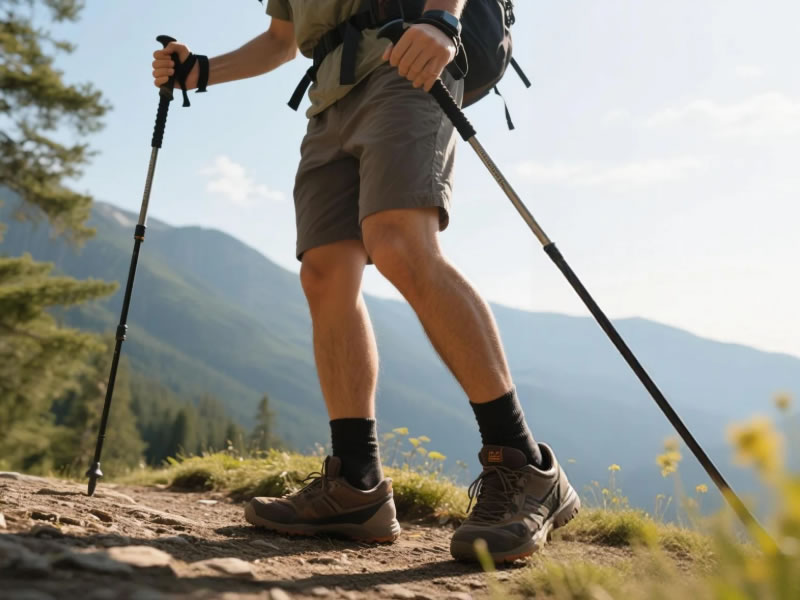
Recommended trekking pole purchase link: https://s.click.aliexpress.com/e/_c4M7OWaN
The Biomechanics of Knee Pain: Why Hiking Hurts
To understand why poles help, you must first understand why knees hurt.
When you walk on flat ground, your knee joints experience forces roughly 1.5 times your body weight with each step. When you hike downhill, this force multiplies dramatically—to 3 to 5 times your body weight. With a heavy backpack, it can exceed 7 times your body weight.
This force is not applied gently. It is a repetitive, high-impact loading event repeated thousands of times per descent. Each step sends a shockwave through your patellofemoral joint (kneecap), compressing cartilage, irritating synovial membranes, and inflaming tendons. Over time, this cumulative microtrauma accelerates osteoarthritis and turns hiking from pleasure to punishment.
The critical insight: This force is not inevitable. It can be redirected.
How Walking Poles Reduce Knee Load
Walking poles act as external shock absorbers and load transfer devices. Here is the biomechanical mechanism:
1. Weight Redistribution:
When you plant a pole ahead of your body and transfer weight onto it, you create an alternative load path. A portion of your body weight and pack weight travels down through your arms, through the pole, and into the ground. This weight never reaches your knees. Studies quantify this reduction at 18-28% , with most research settling on approximately 25% reduction in compressive knee forces during downhill walking.
2. Braking Assistance:
On descents, your quadriceps contract eccentrically to control your rate of descent. This eccentric loading is the primary source of downhill knee pain. A properly lengthened pole planted ahead of you acts as a brake, allowing you to lower your body weight onto the pole rather than catching it entirely with your leg muscles.
3. Vibration Dampening:
Hard trail surfaces transmit high-frequency vibration up your skeleton. This microtrauma contributes to joint irritation. Carbon fiber poles and rubber tip protectors absorb and dissipate this vibration before it reaches your knees.
4. Gait Stabilization:
Poles reduce the lateral sway and micro-adjustments your knees must make on uneven terrain. By providing two additional points of contact, they prevent the sudden, jarring shifts that strain collateral ligaments and menisci.
Maximizing Knee Relief: Technique Matters
Poles do not help automatically. You must use them correctly.
Technique #1: Lengthen for Downhills (Non-Negotiable)
Before any descent, lengthen your poles by 5-15 cm (2-6 inches) from your flat-ground setting. A longer pole allows you to plant the tip ahead and downhill of your body. This creates a true braking action. If your poles are too short, you will plant beside or behind your body, providing minimal knee relief.
Technique #2: Master the Wrist Strap
Slide your hand up through the bottom of the strap, then grip the handle. When you plant the pole, push down through the strap, not by squeezing the grip. This transfers weight through your skeleton, not your hand muscles, and is essential for effective load redirection.
Technique #3: Plant with Intent
Each plant should be deliberate. Stab the tip firmly into the ground ahead of you. As you step down, lean into the pole and allow it to bear a portion of your weight. You should feel your arms and shoulders working to support you.
Technique #4: Rhythmic, Opposite Arm/Leg
Maintain an opposite arm/leg rhythm (right pole with left foot). This engages your core and creates a fluid, energy-efficient gait that minimizes jarring impacts.
Choosing the Best Poles for Knee Pain
Not all poles offer equal joint protection. Prioritize these features:
| Feature | Why It Matters | Recommendation |
|---|---|---|
| Shaft Material | Vibration transmission directly affects joint comfort. | Carbon fiber absorbs trail chatter; aluminum transmits it. |
| Grip Material | Moisture-wicking, comfortable grip reduces tension. | Cork (molds to hand, absorbs sweat) or foam. |
| Locking Mechanism | Must hold securely under load without slipping. | External lever locks (FlickLocks) —no exceptions. |
| Shock Absorption | Internal spring further cushions each plant. | Recommended for significant knee pain or arthritis. |
| Adjustability | Essential for changing length between climbs/descents. | Telescoping poles with wide adjustment range. |
| Weight | Heavy poles increase arm fatigue, reducing compliance. | Ultralight carbon fiber ideal; lightweight aluminum acceptable. |
The Verdict: For knee pain, carbon fiber poles with cork grips, external lever locks, and optional shock absorption represent the optimal configuration.
Clinical Context: What Poles Can and Cannot Do
What Poles Can Do:
- Reduce acute pain during and after hiking.
- Enable longer hikes with less joint fatigue.
- Slow the progression of osteoarthritis by reducing cumulative joint loading.
- Allow individuals with existing knee replacements or injuries to return to hiking.
What Poles Cannot Do:
- Cure arthritis or reverse cartilage loss.
- Eliminate pain entirely (especially in severe cases).
- Replace proper medical treatment, physical therapy, or strength training.
Important: If you have been advised against weight-bearing activity by a physician, consult them before using poles. For most individuals, however, poles are recommended, not restricted.
Real-World Impact: The Cumulative Benefit
Consider a 160-pound hiker descending 2,000 vertical feet over 5,000 steps. Without poles, their knees absorb approximately 800,000 pounds of cumulative impact force during that descent. With poles reducing that force by 25%, they spare their knees 200,000 pounds of stress.
In one descent.
Over a season of hiking, this represents millions of pounds of joint preservation. This is not subjective "feeling better"—it is measurable, clinically significant load reduction.
Conclusion: The Most Effective Non-Surgical Intervention
Can walking poles help with knee pain? Yes, unequivocally. The evidence is robust, the mechanism is clear, and the results are reproducible. For the vast majority of hikers with knee pain—whether from osteoarthritis, patellofemoral syndrome, previous injury, or simply the cumulative toll of decades on the trail—walking poles are the single most effective, immediately accessible intervention available.
They are not a cure. They will not regenerate cartilage or eliminate the need for strength training and medical care. But they will allow you to hike longer, recover faster, and protect your joints while doing what you love. For anyone asking whether poles are worth trying for knee pain, the answer is simple: Your knees have been asking for help. This is how you give it.




