




Can Using Hiking Poles Improve Your Posture While Hiking?
Absolutely. Far from being mere accessories for balance, trekking poles are powerful tools for promoting and maintaining proper hiking posture. When used correctly, they act as external guides and supports that actively counteract common postural pitfalls caused by fatigue, heavy loads, and challenging terrain. The improvement is both immediate and biomechanically profound.
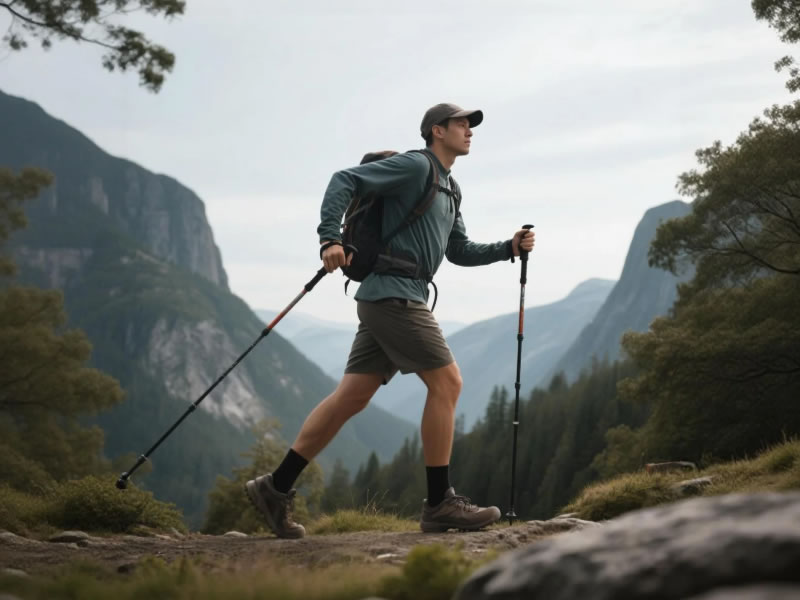
Recommended trekking pole purchase link: https://s.click.aliexpress.com/e/_c4M7OWaN
The Postural Pitfalls of Hiking Without Poles
Without poles, several natural tendencies degrade posture:
- Forward Hunch: Under a heavy backpack, or when fatigued on climbs, hikers often round their shoulders and collapse their chest forward to counterbalance the weight. This strains the neck, upper back, and lower back.
- Leaning Back ("The Barcalounger Stance"): On steep descents, especially with a pack, the instinct is to lean backward for safety, placing immense strain on the lumbar spine and quads.
- Collapsed Stride: Fatigue leads to a shortened, shuffling gait with less core engagement and a more slumped torso.
How Poles Actively Correct and Improve Posture
1. Providing Support to Stay Upright:
Poles offer two additional points of contact. This external support allows you to resist the forward-pulling force of your backpack. Instead of rounding forward to compensate, you can maintain a tall, open-chested position. The poles essentially act as outriggers, enabling your core and back muscles to work more efficiently to keep you upright.
2. Establishing a Proper Kinematic Baseline:
The fundamental rule for pole length—adjusting so your elbow forms a 90-degree angle when the tip is on flat ground—does more than ensure efficiency. It sets your body in an optimal, upright starting position. This correct alignment encourages your shoulders to stay back and down, your head to be level, and your spine to be in a neutral position.
3. Enabling Terrain-Specific Postural Adjustments (The Key to Dynamic Posture):
This is where poles truly shine for posture.
- On Climbs: Shortening the poles prevents you from overreaching and hunching. It allows you to maintain a forward lean from the ankles while keeping your back relatively straight—the powerful, efficient posture of a climber, not a laborer.
- On Descents: Lengthening the poles is a postural game-changer. It allows you to keep your torso perpendicular to the slope (i.e., more upright) rather than leaning dangerously backward. Your arms and poles absorb the shock, while your spine remains in a safe, neutral alignment. This directly prevents the painful "barcalounger" stance.
4. Engaging Core and Promoting a Rhythmic Gait:
The opposite-arm, opposite-leg motion of poling is not just for propulsion. It engages your oblique and transverse abdominal muscles with each rotation. This active, braced core is the foundation of good posture. The rhythmic swing also promotes a more consistent, full-stride walking pattern, preventing the collapsed, shuffling gait that worsens posture.
5. Distributing Load and Reducing Fatigue:
Poor posture is often a direct result of muscular fatigue. By transferring up to 25% of the work from your legs and back to your arms and shoulders, poles dramatically reduce systemic fatigue. When you're less exhausted, you're far more capable of holding a strong, upright posture over miles.
Practical Tips for Maximizing Postural Benefits
- Use the Straps Correctly: Slip your hand up from the bottom. This allows you to push through the strap with an open palm, engaging larger back muscles (like the lats) that are crucial for good posture, rather than just gripping with your hands and arms.
- Focus on the "Push": Concentrate on a powerful rearward push with each pole plant. This activates the postural muscles of your upper back.
- Check Your Length: Recalibrate your 90-degree baseline periodically and always adjust for terrain.
- Look Ahead: Your gaze directs your posture. Look at the trail 10-15 feet ahead, not at your boots. Your head (weighing 10-12 lbs) will follow, bringing your spine into better alignment.
A Note on Incorrect Use
Poles can hurt posture if used incorrectly. Using poles that are too long can force your shoulders into a constant shrug. Using them too short can cause you to bend over. "Planting" them too far in front of your body creates a braking motion and encourages a forward lean.
The Verdict: A Resounding Yes, With Proper Technique
Hiking poles are not a magic bullet, but they are a highly effective tool for promoting and preserving good hiking posture. They provide the external support and mechanical advantage needed to counteract the forces that lead to poor alignment.
By enabling an upright torso, facilitating terrain-specific adjustments, engaging the core, and reducing fatigue, they transform hiking from an activity that can stress the spine into one that actively supports it. The result is not just a more efficient and powerful hike, but one that is significantly more comfortable and sustainable for your body over the long miles and years ahead.




