




The Physics Behind How Hiking Poles Reduce Impact on Joints
The benefit of trekking poles for joint protection isn't just anecdotal; it's grounded in fundamental physics and proven by biomechanical research. The core principle is simple: redistributing and dissipating the forces that would otherwise be absorbed solely by the lower body. This process involves two key concepts: force distribution and the manipulation of lever arms.
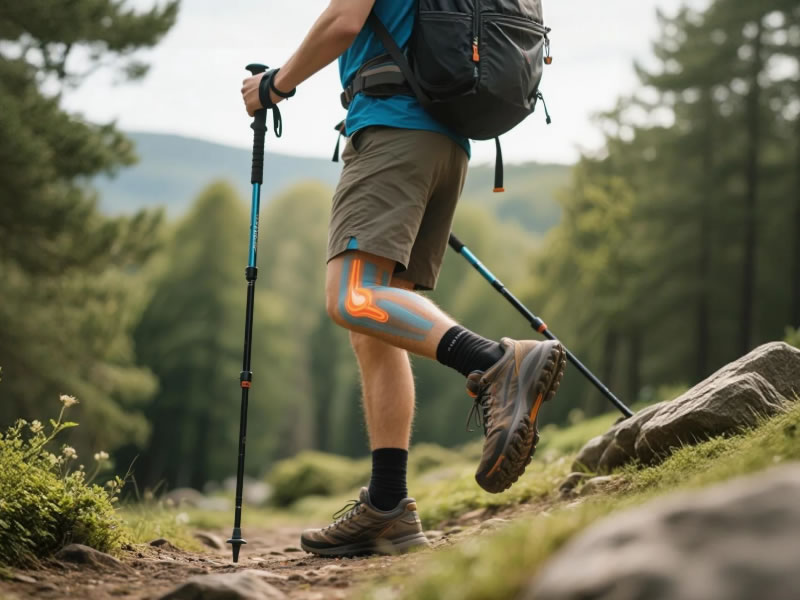
Recommended trekking pole purchase link: https://s.click.aliexpress.com/e/_c4M7OWaN
1. Force Distribution: Sharing the Load
When you walk or hike, your body must manage the force generated by gravity acting on your mass, amplified by momentum and the weight of your pack. This force peaks during the "loading response" phase of your gait—the moment your foot strikes the ground.
- Without Poles: This peak force travels up through your ankle, knee, hip, and spine. The compressive force on the knee joint, in particular, can reach 3-4 times your body weight during a descent.
- With Poles: When you plant a pole and apply downward pressure through your arm, you create an additional pathway for that force. A portion of your body's weight is now supported by your arms, shoulders, and back muscles. Studies using force plates and motion analysis, such as those published in the Journal of Sports Sciences, consistently show that using two poles can reduce the compressive load on the knees by approximately 20-25% on level ground and even more on descents.
The Physics: You are effectively increasing the number of "columns" supporting the structure (your body). Two legs provide two load paths; adding two poles creates four. This directly lessens the force each leg must bear per step, a cumulative reduction over thousands of steps per hike.
2. The Lever Arm Effect: Controlling Descent Forces
The most dramatic joint-saving effect occurs during downhill hiking, and this is where leverage physics takes center stage.
- The Problem (Short Lever): On a descent without poles, your body's center of mass is behind your foot strike. Your quadriceps and knees must act as the primary brakes, eccentrically contracting to control your downward motion. This creates massive shear and compressive forces in the knee.
- The Solution (Extended Lever): By lengthening your poles for a descent, you effectively lengthen your "braking lever arm." You can now place your hands (the point of force application) significantly farther down the slope and ahead of your body.When you plant a long pole and lean on it, you create a fulcrum at the pole tip. Your arm muscles then work to control the rate at your body rotates forward over this fulcrum.This allows your arms and upper body to perform a significant portion of the braking work. The impact energy is absorbed by the muscles of your arms, shoulders, and back—larger muscle groups better suited to the task—before it ever reaches your knees.
The Physics: The longer the pole (the lever), the greater the mechanical advantage for controlling your forward rotation. This transfers the shock-absorption duty away from the vulnerable knee joint to more robust musculoskeletal structures.
3. The Role of Technique: Vector Control
Proper technique ensures efficient force transfer. Using the wrist strap correctly is crucial physics.
- By slipping your hand up through the strap and pushing down on it, you align the force vector directly through the bones of your wrist and arm. This allows you to transmit force skeletally with minimal muscular effort in your grip.
- Incorrectly gripping the handle relies on smaller hand and forearm muscles, which fatigue quickly and are less efficient at transferring large forces.
4. Reducing Cumulative Micro-Trauma
Beyond peak forces, poles also mitigate the repetitive, high-frequency vibrations (the "buzz") from rough trails. Carbon fiber poles, in particular, dampen these vibrations. This reduces muscle fatigue and connective tissue strain in the legs, which over long distances contributes to joint stability and health.
The Verdict: A Simple Machine for Joint Preservation
In essence, a trekking pole is a class-1 lever that you deploy thousands of times per hike. It changes the dynamics of your movement by:
- Increasing your base of support to distribute weight away from your legs.
- Extending your lever arm to allow your upper body to manage descent forces.
- Providing earlier ground contact to smooth out and control your center of mass.
The cumulative effect is a profound reduction in the mechanical stress on the cartilage, ligaments, and tendons of the ankles, knees, and hips. This isn't just about comfort—it's about applying basic physics to preserve the long-term health of your joints, enabling you to hike farther and more often with a significantly lower risk of pain or injury.




