




Tips for Using Hiking Poles in Thick Mud Without Getting Stuck
Thick, sucking mud is one of the most challenging terrains for a hiker and their gear. It can cling to boots, sap energy, and turn trusty trekking poles into frustrating anchors. The goal shifts from propulsion to strategic stability, requiring a modified technique focused on prevention, rapid assessment, and clean extraction.
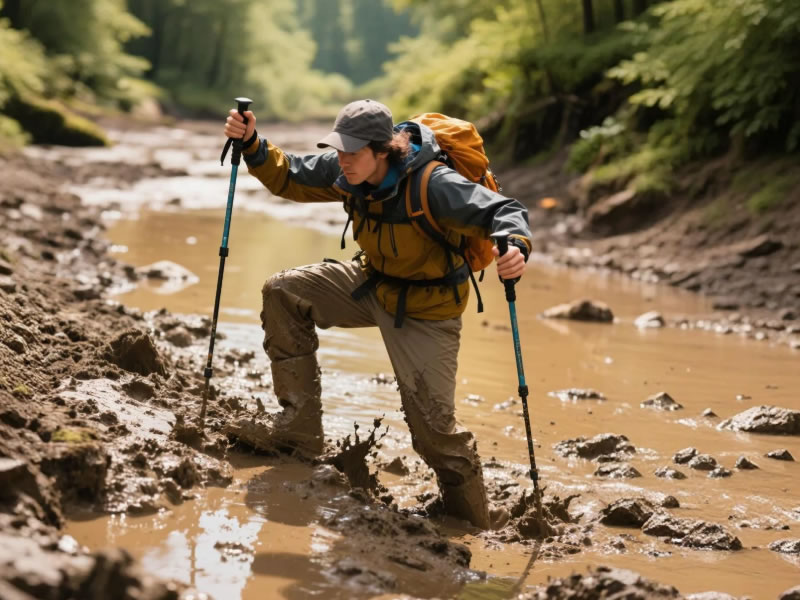
Recommended trekking pole purchase link: https://s.click.aliexpress.com/e/_c4M7OWaN
1. Preparation and Pole Setup
Before you step into the mire, optimize your equipment.
- Remove the Baskets: Take off all trekking baskets. They act like small shovels, scooping mud and creating suction that will hold your pole fast.
- Sharpen Your Tips: Ensure your carbide tips are clean and sharp. A sharp point will penetrate surface debris (leaves, roots) more cleanly to find firmer substrate underneath.
- Lock Check: Verify your locking mechanisms (preferably external flip locks) are fully secure. A collapsing pole in deep mud is a nightmare to retrieve and reassemble.
2. The Modified Planting Technique: Probe, Don't Plunge
Forget the powerful, committing plant used on firm ground. In mud, your pole is a probe and a pivot, not an anchor.
- The "Tap Test" Plant: Use a lighter, quicker, more vertical motion. Tap the intended spot to assess depth and suction before putting any weight on it. Listen and feel: a shallow thud is better than a deep, silent sink.
- Aim for Solid Footing: Look for and target micro-features within the mud: the side of a root, a rock, a grassy tuft, or the compacted edge of a footprint. These provide vastly more resistance than the pure slurry.
- Angle for Leverage, Not Depth: Plant with a steeper angle than normal. The goal is to have the pole enter and exit cleanly. A shallow angle increases surface contact and the likelihood of bending the shaft if it gets stuck.
3. Leverage and Weight Distribution
This is the core of stability in mud.
- Use Poles for Balance, Not Support: In deepest mud, you cannot rely on poles to hold significant weight. They are for momentary balance as you move your feet. Keep your weight centered over your feet, using the poles as outriggers for lateral stability.
- The "Quick Touch" Method: Touch the pole to the firm spot you've identified, use it for a brief moment of balance as you step past it, and immediately lift it for the next placement. Minimize the time the tip is submerged.
- Wide Stance: Widen your gait. This lowers your center of gravity and provides a more stable platform when each footstep is uncertain.
4. The Art of the Clean Extraction
When a pole does sink deep, how you remove it is critical to avoid damage or a fall.
- Pull Straight Up: The number one rule. If the pole is stuck in suction mud, apply firm, steady, vertical upward force. Do not yank or wiggle excessively at an angle, as this can bend aluminum shafts or stress carbon fiber.
- Break the Seal: If straight up isn't working, gently rotate the pole back and forth while pulling. This can break the vacuum seal created by the mud around the shaft.
- Two-Pole Stability: If one pole is deeply stuck, ensure the other is securely placed before you commit to pulling, so you don't lose balance.
5. Post-Mud Care (Non-Negotiable)
Mud is abrasive and corrosive. Failing to clean your poles after a muddy hike will ruin the locking mechanisms.
- Field Clean: At the next stream or with a water bottle, extend the poles fully and rinse the lower sections, especially where the shafts telescope into each other. Work the locks open and closed under water to flush out grit.
- Home Clean: At home, give them a thorough wash. Disassemble them completely if possible. Dry them fully before storage to prevent corrosion.
- Lubricate: After cleaning and drying, apply a dry lubricant (like silicone spray) to the internal mechanisms of twist locks, or a drop of light oil to lever lock pivots, wiping away all excess.
Summary: The Mud-Wise Mindset
Navigating mud with poles is about finesse and terrain reading, not power.
- Probe First: Tap, don't trust.
- Target Firm: Aim for roots, rocks, and edges.
- Touch, Don't Lean: Use poles for quick balance checks.
- Extract Vertically: Pull straight up with steady force.
- Clean Religiously: Your poles' longevity depends on it.
By adopting these techniques, you transform your poles from potential liabilities into effective tools for maintaining balance and momentum, allowing you to conquer the muddiest trails with greater confidence and control.




